
A website redesign is the process of overhauling a site's structure, design, content, and functionality to restore its effectiveness and alignment with business goals. This is not a cosmetic exercise. Why website redesigns become necessary is a question every business owner and web manager eventually faces, and the answer almost always involves a combination of technical debt, shifting user expectations, and missed revenue. Bad redesigns cause 30–40% underperformance in conversion metrics compared to the sites they replaced. That number shows how high the stakes are when you get the decision wrong in either direction.
Why website redesigns become necessary: the core drivers
The most common reasons for website redesign fall into five categories: technical limitations, poor user experience, brand misalignment, SEO deficiencies, and competitive pressure. Each one can independently justify a full overhaul. Together, they make inaction expensive.
- Technical debt and legacy architecture. CMS limitations and outdated site architecture directly constrain how fast your marketing team can publish, test, and update content. When your platform fights every change you try to make, the site stops evolving.
- Poor mobile usability. Mobile usability issues affect more than 60% of site traffic and actively harm SEO rankings under Google's mobile-first indexing. A site that breaks on a phone loses customers before they read a single word.
- Brand and business model shifts. Redesigns become necessary when a site no longer reflects the current business model, brand identity, or product offering. A pivot, acquisition, or rebranding without a corresponding site update sends mixed signals to every visitor.
- SEO and content strategy gaps. Thin content, missing metadata, and unstructured page architecture all suppress organic rankings. These issues compound over time and rarely fix themselves with minor edits.
- Competitive pressure. When your competitors' sites load faster, convert better, and look more credible, the gap in perception becomes a gap in revenue. Visitors make trust decisions in seconds.
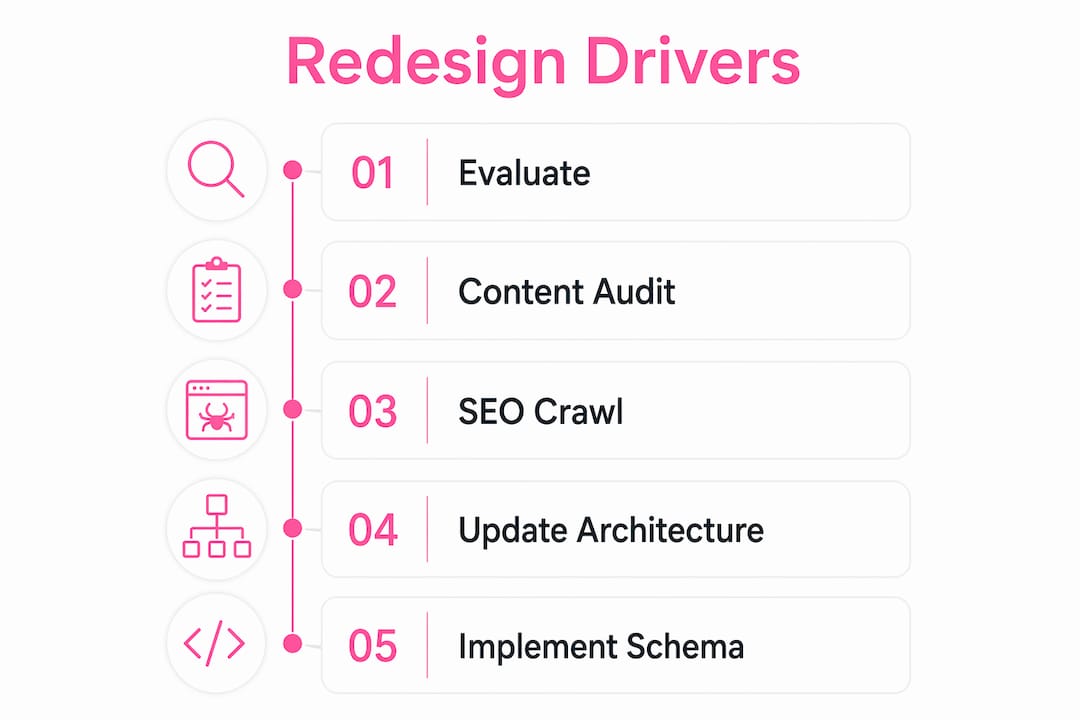
Pro Tip: Before committing to a full redesign, run a content audit and a technical SEO crawl. You may find that 40% of your pages drive 90% of your traffic. Protect those pages first.
The importance of site updates is not just about aesthetics. Outdated architecture is a structural problem, and structural problems require structural solutions. Reviewing website investment best practices before scoping a redesign helps you avoid spending money on the wrong fixes.

How do AI search and schema markup change redesign requirements?
AI-driven search has added a new layer of urgency to redesign decisions. Google's AI Overviews, Perplexity, and similar tools do not just rank pages. They extract structured answers from them. Sites that lack the right architecture get ignored entirely.
AI Overviews triggered on about 18% of queries in early 2025, and that share is growing. That means nearly one in five searches now returns an AI-generated answer instead of a traditional list of links. If your site is not structured to feed those systems, you are invisible to a growing slice of your audience.
The technical requirements for AI visibility are specific:
- Schema markup. Structured data tells AI systems what your content means, not just what it says. Without it, your pages are harder to parse and less likely to be cited.
- FAQ sections. Question-and-answer formatting maps directly to how AI systems retrieve and present information.
- Clear citations and sourcing. AI tools favor content that demonstrates authority through named entities, statistics, and verifiable claims.
Content structured with schema markup, FAQs, and clear citations can increase AI-driven search visibility by up to 40%. That is a significant return on a structural investment that most older sites simply cannot support without a redesign. Understanding schema.org structured data and how it works is a practical starting point for any web manager evaluating this gap.
Older site architectures built on page builders or legacy CMS platforms often cannot implement schema markup cleanly. The templates are too rigid, the code output too bloated, and the page structure too inconsistent. That is a redesign trigger, not a plugin fix.
What are the signs your website is underperforming?
Measurable signals tell you when a site has stopped doing its job. You do not need to guess. The data makes the case.
- Conversion rates fall while traffic holds steady. Declining conversions despite stable traffic signal a design or functionality problem, not a marketing problem. Sending more visitors to a broken funnel only amplifies the loss.
- Bounce rates climb without explanation. High bounce rates on key landing pages indicate that visitors are not finding what they expected. This is usually a mismatch between ad copy or search intent and what the page actually delivers.
- Site speed is slow. Page load time directly affects both SEO rankings and user satisfaction. A site that takes more than three seconds to load loses a measurable share of visitors before the page even renders.
- Content management is painful. If your team needs developer help to update a blog post or change a headline, the CMS is a bottleneck. That friction slows your entire content operation.
- The design is more than three to five years old. Design ages faster than most business owners expect. A site that looked modern in 2020 now reads as dated, and that perception affects trust before a visitor reads a single word.
Pro Tip: Check your conversion rate data against industry benchmarks before assuming your site needs a full redesign. Sometimes a targeted landing page test reveals the problem faster and cheaper than a full overhaul.
Understanding why websites need regular updates helps you distinguish between sites that need incremental maintenance and sites that need a full rebuild. The distinction matters for budget and timeline planning.
How does governance prevent redesign benefits from fading?
A redesign launch is the beginning of a system, not the end of a project. This is the part most business owners miss. Launching without a governance framework causes site coherence and benefits to fade within 6–12 months. The investment decays because no one owns the ongoing work.
Governance means defining who can update what, how often, and according to what standards. Without it, pages go stale, brand consistency breaks down, and technical debt starts accumulating again from day one.
A practical governance framework covers:
- Content ownership. Every section of the site has a named owner responsible for accuracy and freshness.
- Update workflows. Clear processes for publishing, reviewing, and retiring content prevent bottlenecks and inconsistency.
- Technical oversight. Someone monitors site speed, broken links, plugin updates, and security patches on a regular schedule.
- AI SEO evolution. Search behavior changes continuously. Governance includes a process for reviewing and updating structured data as requirements shift.
Many redesign projects fail because the brief was built on outdated web assumptions, missing both AI readiness and operational governance. A site built without these considerations will need another redesign sooner than it should.
What practical steps should you take before redesigning?
The difference between a redesign that delivers results and one that wastes budget comes down to preparation. Most failures are preventable.
| Phase | Key action | Why it matters |
|---|---|---|
| Analytics audit | Review traffic, conversions, and top pages | Protects high-performing content from accidental damage |
| Content audit | Catalog all pages, assess quality and relevance | Identifies what to keep, consolidate, or cut |
| Goal setting | Define measurable outcomes tied to business objectives | Keeps the project focused and accountable |
| URL redirect planning | Map all existing URLs to new equivalents | Sites without redirect planning lose 20–50% of organic traffic in the first 90 days |
| User research | Gather data on how real visitors use the current site | Pre-redesign analytics review reduces risk of underperformance by 30–40% |
| Governance planning | Define ownership, workflows, and update schedules | Sustains results after launch |
The website readiness checklist is a practical tool for working through these phases before committing to a scope or budget. Skipping any phase increases the probability of a redesign that underperforms its predecessor.
Key Takeaways
A website redesign becomes necessary when technical debt, poor user experience, or misaligned business goals make the current site a liability rather than an asset.
| Point | Details |
|---|---|
| Redesign is structural, not cosmetic | Address architecture, content, and governance, not just visual appearance. |
| Mobile and AI readiness are non-negotiable | Over 60% of traffic is mobile, and AI Overviews now shape nearly 1 in 5 search results. |
| Governance sustains results | Without defined ownership and update processes, redesign benefits fade within 6–12 months. |
| Redirect planning protects SEO | Skipping URL redirects risks losing 20–50% of organic traffic in the first 90 days post-launch. |
| Data drives better outcomes | Pre-redesign analytics and user research reduce the risk of underperformance by 30–40%. |
The mistake I see most often in redesign projects
Most redesign projects I have seen fail in the same way. The business owner decides the site looks old, hires someone to make it look new, and launches without touching the underlying architecture, content strategy, or governance structure. Six months later, the rankings have dropped, the conversion rate is flat, and the team is frustrated.
The uncomfortable truth is that visual refresh and actual redesign are two different things. A new color palette does not fix a slow server. A new font does not fix broken schema markup. A new homepage hero image does not fix a navigation structure that confuses visitors on their second click.
The businesses that get the most from a redesign treat it as a strategic audit first and a build project second. They spend real time on analytics before they spend money on design. They define what success looks like in measurable terms, not subjective ones. And they build governance into the project plan from day one, not as an afterthought.
Iterative improvement is often more effective than a full overhaul. If your core architecture is sound, targeted fixes to speed, content structure, and conversion paths can deliver results faster and with less risk. Save the full redesign for when the foundation itself is the problem.
Approach redesign as a business decision backed by data, not a reaction to how the site looks compared to a competitor's. That shift in framing changes everything about how the project runs and what it delivers.
— Ville
Verkkosivu builds sites that perform from day one
A redesign only delivers results when performance, SEO, and user experience are built in from the start, not bolted on afterward.

Verkkosivu designs custom websites that load in under one second, pass technical SEO requirements, and are built without templates. Every project includes schema markup, A/B testing capability, and a clear governance handoff so your team can manage the site confidently after launch. With more than 100 completed projects and a perfect 5-star rating on Google, Verkkosivu delivers fast, with most sites ready within 48 hours. If your current site is holding your business back, see what Verkkosivu builds and get a clear picture of what a properly executed redesign looks like.
FAQ
Why do website redesigns become necessary?
Website redesigns become necessary when a site can no longer support business goals, user expectations, or current technical standards. Common triggers include poor mobile performance, declining conversions, outdated architecture, and brand changes.
How often should you redesign a website?
Most business websites need a meaningful redesign every three to five years. Design ages quickly, and technology requirements, especially around mobile usability and AI search, shift faster than incremental updates can address.
What are the biggest risks of a website redesign?
The biggest risks are losing organic traffic through poor URL redirect planning and shipping a design that underperforms the original. Sites without redirect planning lose 20–50% of organic traffic in the first 90 days after launch.
What are the signs your website needs a makeover?
Clear signs include falling conversion rates despite steady traffic, high bounce rates on key pages, slow load times, a design older than three to five years, and a CMS that requires developer help for basic content updates.
Does a redesign always improve SEO?
Not automatically. A redesign improves SEO only when it includes technical fixes, structured data implementation, URL redirect planning, and content improvements. A redesign that ignores these factors can actively harm rankings.