
Conversion rate optimization (CRO) is the systematic process of increasing the percentage of website visitors who complete a desired action, whether that means making a purchase, filling out a form, or signing up for a newsletter. The role of conversion rate optimization explained simply is this: you already have traffic, and CRO makes that traffic work harder. Rather than spending more on ads or SEO to attract new visitors, CRO extracts more value from the visitors you already have. Tools like Google Analytics, Hotjar, and Matomo power this process with real behavioral data, making CRO one of the most measurable disciplines in digital marketing.
Why is conversion rate optimization important for small businesses?
CRO delivers better returns than simply buying more traffic. The math is direct: improving conversion rate from 2% to 3% yields 50% more revenue from the exact same number of visitors. That is not a small gain. It is the difference between a campaign that breaks even and one that funds your next quarter.
For small businesses with limited budgets, this efficiency matters enormously. Paid ads cost $2–$5 per click, and every click you fail to convert is money gone. CRO ROI ranges from 200% to 1,000% within 90 days for teams that test regularly. Those teams also see 37% higher conversion gains compared to businesses that test sporadically.
CRO also strengthens every other marketing channel you run:
- SEO brings organic traffic to your pages. CRO converts that traffic into leads and sales.
- Paid search drives clicks at a fixed cost per visit. CRO lowers your effective cost per acquisition.
- Email marketing sends warm prospects to landing pages. CRO determines whether those pages close the deal.
CRO amplifies rather than replaces SEO or paid campaigns. Optimized pages perform better across every channel because the underlying user experience is stronger. The average conversion rate across sectors is 3.3%, with top performers reaching 10% or higher. That gap between average and top performer is almost entirely explained by disciplined CRO practice.
Pro Tip: Before launching any new ad campaign, audit your landing page first. Sending more traffic to a page that converts at 1% is a guaranteed way to waste budget.
What are the most effective conversion rate strategies?
The most effective conversion rate strategies start with research, not guessing. 80% of effective CRO is research: analyzing visitor behavior through heatmaps, session recordings, and analytics. Only 20% is actual testing. Skipping the research phase and jumping straight to A/B tests is the single most common mistake small business marketers make.
Here is a practical sequence to follow:
- Collect behavioral data. Use tools like Hotjar or Microsoft Clarity to record real user sessions. Watch where visitors click, scroll, and drop off. Identify the exact moment they leave without converting.
- Identify your highest-impact pages. Focus on pages with significant traffic and low conversion rates. A product page that gets 5,000 visits per month and converts at 1% is a higher priority than a blog post with 200 visits.
- Fix headline clarity first. Headline clarity, CTA prominence, and reducing form friction are the highest-impact CRO levers available. A vague headline loses visitors in the first three seconds. A clear, specific headline keeps them reading.
- Reduce form friction. Every extra field in a form reduces completions. If you are asking for a phone number when an email address is enough, you are losing leads unnecessarily.
- Run A/B tests with statistical significance. Test one variable at a time. Do not call a winner until the data is statistically significant. A/B testing is indispensable but must be prioritized carefully to avoid false positives that send you in the wrong direction.
- Measure page speed as a conversion variable. A one-second page load delay reduces conversions by 7%. Three seconds causes a 32% bounce increase. For a business generating $100,000 per month, each additional second of load time costs $7,000 monthly. Speed is not a technical detail. It is a revenue lever. Read more about why load speed matters for both SEO and conversions.
Pro Tip: Run your site through Google PageSpeed Insights before any other CRO work. If your score is below 70 on mobile, fix speed first. Every other optimization you run will underperform on a slow site.
Manual CRO vs. autonomous CRO: which approach fits your business?
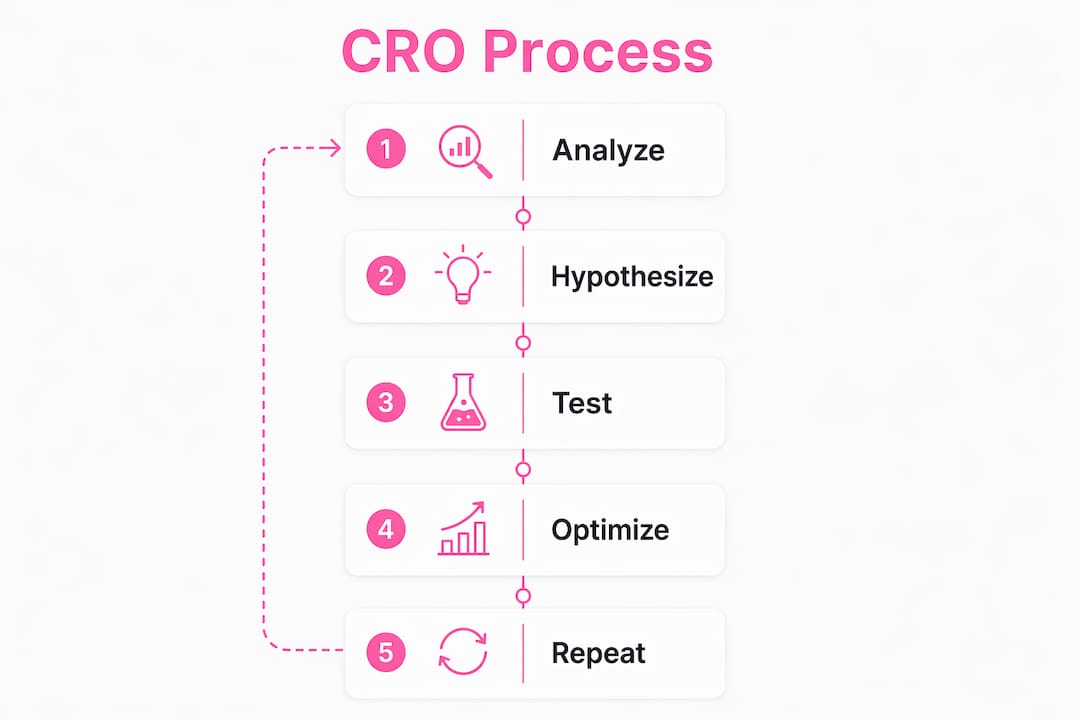
Manual CRO and autonomous CRO represent two distinct approaches to improving conversion rates. Understanding both helps you allocate resources correctly.

| Factor | Manual CRO | Autonomous CRO |
|---|---|---|
| Who runs tests | Human specialists | AI systems |
| Speed of iteration | Days to weeks | Nightly or continuous |
| Scale of testing | Limited by team capacity | Whole-site simultaneous |
| Cost structure | Specialist time and tools | Software subscription |
| Best for | Targeted, high-stakes pages | Large sites with many variables |
Manual CRO relies on human-driven hypothesis formation, design changes, and test setup. A marketer identifies a problem, proposes a solution, builds a variant, and runs the test. This approach works well for focused campaigns and high-traffic landing pages where the stakes are high and the context is nuanced.
Autonomous CRO systems represent 2026's most significant shift in the field. AI runs experiments nightly without human intervention, generating variants, testing them across entire sites, and iterating based on results. This frees specialists to focus on strategy rather than execution. For small businesses without a dedicated CRO team, autonomous tools available through platforms like Signal Engine can fill the gap at a fraction of the cost of hiring a specialist.
The practical answer for most small businesses is a hybrid approach. Use manual CRO for your most critical pages, such as your homepage, primary product or service page, and main contact form. Use autonomous tools to run continuous tests across lower-traffic pages where manual effort would not be cost-effective.
Common CRO mistakes that kill conversions
Most CRO failures trace back to a small set of repeatable errors. Recognizing them early saves you significant time and money.
- Testing without research. Launching A/B tests before analyzing user behavior is guesswork. Skipping behavioral analysis before testing wastes traffic and produces misleading results. Always start with heatmaps and session recordings.
- Calling tests too early. Ending a test before reaching statistical significance produces false winners. A variant that looks better after three days may reverse after three weeks. Wait for the data to stabilize.
- Using aggressive tactics for short-term gains. Aggressive pop-ups or high-pressure sales tactics may spike conversions briefly but damage brand trust over time. Sustainable CRO focuses on easing the user journey, not pressuring visitors into decisions.
- Ignoring the full funnel. Optimizing your homepage while ignoring your checkout flow or contact form is a partial solution. Conversion problems often live deeper in the funnel than marketers expect. Review your website investment practices to identify where visitors drop off across the entire path.
- Treating CRO as a one-time project. Conversion optimization is continuous. User behavior changes, competitors improve, and market conditions shift. Teams that test regularly outperform those that treat CRO as a quarterly initiative.
The shift from visitor volume to visitor value is the mindset change that separates businesses that grow efficiently from those that chase traffic indefinitely. More visitors do not automatically mean more revenue. Better-served visitors do.
Key takeaways
Conversion rate optimization delivers more revenue from existing traffic by systematically improving how your website turns visitors into customers, making it the highest-ROI investment most small businesses are not fully using.
| Point | Details |
|---|---|
| CRO beats buying more traffic | Improving conversion rate from 2% to 3% yields 50% more revenue with zero extra ad spend. |
| Research drives results | 80% of effective CRO is behavioral research; testing without data wastes traffic and budget. |
| Speed is a conversion variable | A one-second load delay reduces conversions by 7%, making site speed a direct revenue factor. |
| Autonomous CRO scales testing | AI-driven tools run nightly experiments across entire sites, reducing specialist workload significantly. |
| Avoid trust-killing tactics | Aggressive pop-ups boost short-term numbers but damage brand credibility and long-term conversion rates. |
The mindset shift that actually moves the needle
Working with small business clients over the years, I have noticed one pattern more than any other: owners obsess over traffic numbers while ignoring what happens after visitors arrive. They celebrate a spike in sessions from a new ad campaign, then wonder why revenue did not follow. The answer is almost always on the page, not in the channel.
The businesses that grow consistently are the ones that treat every visitor as a resource to be respected, not a number to be counted. They ask: "Why did this person leave without converting?" not "How do we get more people here?" That question leads to real answers. A confusing headline. A form with too many fields. A page that loads in four seconds on mobile.
I also think the CRO community undersells the compounding effect of small improvements. A 10% lift in conversion rate this month, followed by another 8% next month, followed by a 12% gain from a speed fix, adds up to a fundamentally different business within a year. None of those individual wins look dramatic in isolation. Together, they are transformative.
My advice: start with your single highest-traffic, lowest-converting page. Fix the headline. Simplify the CTA. Measure the result. Then move to the next page. You do not need an AI platform or a specialist agency to begin. You need a clear process and the discipline to follow it.
— Ville
Build a website that converts from day one
Understanding CRO principles is the first step. Having a website built to support them is the second.
Verkkosivu builds custom websites that load in under one second, include built-in A/B testing support, and are structured around clear conversion paths from the start. Every site is built without templates, tailored to your specific business goals, and delivered with full SEO optimization included. With more than 100 successful projects and a perfect 5-star rating on Google, Verkkosivu delivers results fast, often within 48 hours, and without hidden costs. If you are ready to stop losing conversions to slow load times and unclear CTAs, explore what Verkkosivu offers and see how a properly built site changes the numbers.
FAQ
What is conversion rate optimization?
Conversion rate optimization (CRO) is the process of increasing the percentage of website visitors who complete a desired action, such as making a purchase or submitting a form, using data and testing rather than guesswork.
What is a good conversion rate for a small business website?
The average conversion rate across industries is 3.3%, with top-performing sites reaching 10% or higher. Most small businesses should target 3%–5% as a realistic starting benchmark.
How do i start improving my conversion rate?
Start by analyzing user behavior with tools like Hotjar or Microsoft Clarity before running any tests. Identify your highest-traffic, lowest-converting pages and fix headline clarity, CTA placement, and form length first.
How does CRO work with SEO and paid ads?
CRO amplifies the results of SEO and paid campaigns by converting the traffic those channels deliver. Better-optimized pages lower your effective cost per acquisition across every channel you run.
Is autonomous CRO worth it for small businesses?
Autonomous CRO tools that use AI to run continuous tests are worth considering for businesses without a dedicated CRO specialist. They run experiments nightly at scale, freeing you to focus on strategy rather than test setup.