
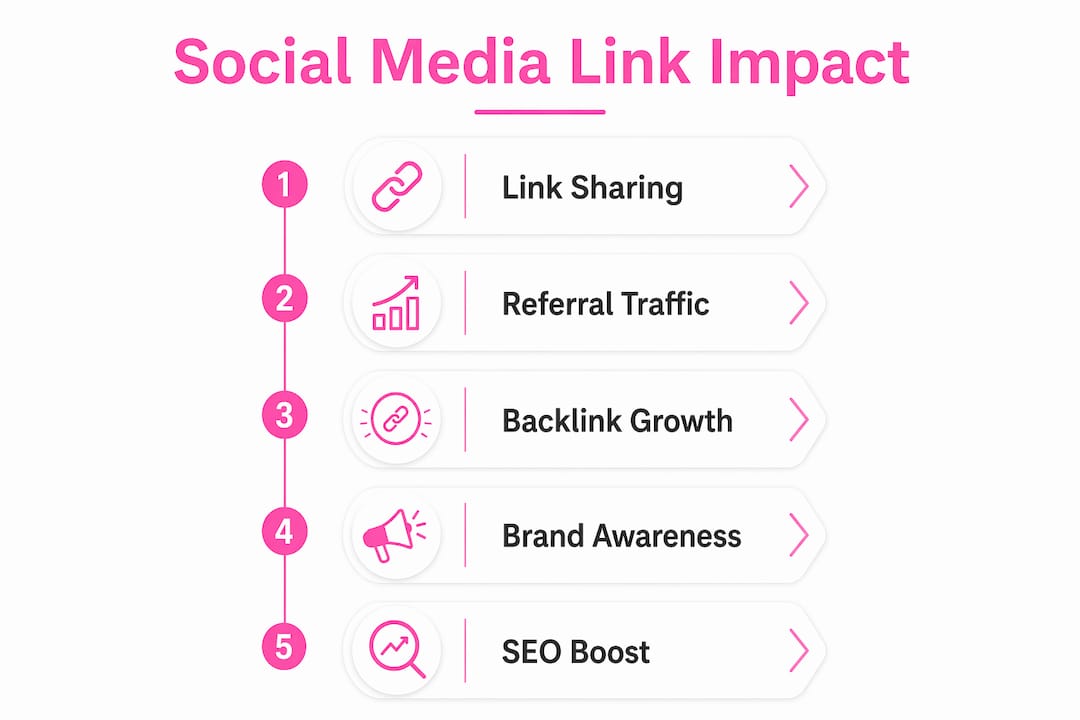
Social media links on your website are defined as any connection between your web presence and your social profiles, posts, or shared content. They serve as one of the most underused tools for driving referral traffic and building brand authority. Small business owners who treat social linking as an afterthought miss a real opportunity. The role of social media links on websites goes well beyond aesthetics. These links accelerate backlink acquisition, increase branded search volume, and send engagement signals that search engines interpret as trust.
How do social media links indirectly boost SEO and website traffic?
Social media links are not direct Google ranking factors. Their power comes from what they trigger downstream. Social signals like shares and likes accelerate backlink acquisition, which is the actual ranking currency. Pages ranking first on Google have 3.8x more backlinks than lower-ranked pages. Social media is the distribution engine that puts your content in front of the journalists, bloggers, and site owners who create those backlinks.
The impact of social media links on referral traffic is equally concrete. When visitors arrive from a social post, they tend to be pre-qualified. They already saw a preview of your content and chose to click. Referral traffic from social posts improves session duration and lowers bounce rates. Search engines read those engagement metrics as signals of content quality.

Branded search volume is the third mechanism. When your content circulates on social media, more people search for your business by name. Higher branded search volume signals trust and authority to Google. That signal contributes to organic ranking improvements over time. It is one of the few SEO benefits you can build through social activity without touching your website's code.
Key mechanisms at a glance:
- Backlink acceleration: Social distribution exposes content to potential linkers faster than organic discovery alone.
- Engagement metrics: Pre-qualified social visitors spend more time on site, reducing bounce rates.
- Branded search lift: Social presence drives name searches, which Google treats as an authority signal.
- Faster indexing: Google crawls socially amplified content more quickly, shortening the time to ranking.
For small business owners building a web presence from scratch, these indirect SEO benefits compound quickly when social linking is built into the strategy from day one.
What platform-specific challenges affect social media link effectiveness?
Not all platforms treat external links equally. Most major platforms suppress posts that contain outbound links. The goal is to reduce spam and keep users on the platform longer. Posts with external links face roughly 40–50% reach reduction in discovery feeds. That suppression is not uniform. Links to high-authority domains face lighter penalties than links to smaller or niche sites.
The practical consequence is significant. A post you publish with a link to your website may reach fewer than half the followers a link-free post would reach. That is a steep cost for a small business with a limited audience. Understanding this dynamic changes how you approach social media for website traffic.
Workarounds that preserve reach without sacrificing link accessibility:
- Reply placement: Post your main content without a link, then add the link in the first reply. This bypasses the reach penalty while keeping the link visible.
- Bio links: Place your primary website link in your profile bio. Reference it in posts with a phrase like "link in bio."
- Pinned comments: On platforms that support it, pin a comment with the link below your main post.
- Link in stories: On Instagram and similar platforms, stories often face lighter suppression than feed posts.
Pro Tip: Test link placement by publishing the same content twice in the same week. One version with the link in the post body, one with the link in the first reply. Compare reach and click data after 48 hours. The difference will clarify your best approach on each platform.
Savvy marketers adapt to platform constraints creatively rather than accepting reduced reach as inevitable. The platform algorithm is not your enemy. It is a constraint you can work within once you understand the rules.
Why does content identity matter for social media sharing?
The psychology of sharing is more specific than most marketers realize. 94% of people consider how content reflects on their identity before sharing it. People do not share information. They share content that makes them look good, informed, or aligned with their values. This concept is called social currency, and it is the engine behind organic link growth.
"People share content that enhances their identity by signaling values rather than just informational content. Brands that understand audience identity and emotional needs outperform by creating shareable content that enhances the sharer's social image."
Emotional contrast amplifies this effect. Viral content combines emotional contrast and visual storytelling to drive engagement and natural backlink acquisition. Content that evokes conflicting emotions, such as hope alongside a challenge, or surprise alongside recognition, gets shared more than content that delivers a single flat emotion. For a small business, this means your social posts should not just inform. They should make the reader feel something worth passing on.
Practical content principles that drive sharing:
- Lead with identity alignment: Frame content around values your audience publicly holds, not just problems they privately face.
- Use emotional contrast: Pair a challenge with a resolution, or a surprising fact with a reassuring takeaway.
- Make the sharer look good: Ask yourself whether sharing your post would make someone appear knowledgeable or thoughtful to their followers.
The importance of social media sharing is not just about volume. A single share from a respected voice in your industry can generate more backlinks than a hundred shares from casual followers. Quality of distribution matters as much as quantity.
How can small businesses integrate social media links on their websites?
Effective social media integration on a website follows a clear structure. The goal is to make your social presence visible without cluttering the user experience. Here is a practical framework for small business owners:
- Place social icons in the header or footer. These locations are expected by visitors and do not interrupt the reading experience. Use recognizable icons with clear labels.
- Add share buttons to blog posts and product pages. Make it frictionless for visitors to share your content directly from your site.
- Link your social profiles from your About page. This builds brand trust and gives visitors a way to verify your business across platforms.
- Embed social proof. Pull in recent posts or reviews from your social profiles to show active engagement.
- Use a staged link strategy. Separate the attention phase from the conversion phase. Earn attention with engaging, link-free content, then use bio or pinned comment links for conversions.
Measuring the impact of social media integration requires tracking the right metrics. The table below shows what to monitor and why each metric matters.
| Metric | What it tells you |
|---|---|
| Referral traffic from social | Volume of visitors arriving via social links |
| Session duration (social visitors) | Whether social traffic is pre-qualified and engaged |
| Branded search volume | Whether social presence is building name recognition |
| Backlinks acquired | Whether content distribution is generating link opportunities |
| Bounce rate (social visitors) | Whether landing pages match social content expectations |
Pro Tip: Set up a separate Google Analytics segment for social referral traffic. Compare session duration and pages per visit against your organic traffic baseline. If social visitors underperform, your landing page likely does not match the promise of the social post.
Understanding how SEO integrates with your website launch from the start makes social media link strategies far more effective. Social and SEO are not separate channels. They feed each other when the website is built to receive and convert social traffic properly.
Link-building through social media works best when your website loads fast, presents clear calls to action, and gives visitors a reason to stay. A slow or confusing website wastes every click your social posts generate.
Key Takeaways
Social media links drive website growth indirectly through backlink acceleration, referral traffic quality, and branded search signals, not through direct ranking influence.
| Point | Details |
|---|---|
| Social links are indirect SEO tools | They accelerate backlink acquisition and branded search, not direct rankings. |
| Platform suppression is real | External links reduce post reach by 40–50%; use reply or bio placement instead. |
| Identity drives sharing | 94% of people evaluate content against their identity before sharing it. |
| Staged link strategy works | Separate attention content from conversion links to maximize both reach and clicks. |
| Measure the right metrics | Track referral session duration, branded search volume, and backlinks, not just clicks. |
What I've learned from watching small businesses get social linking wrong
Most small business owners I work with make the same mistake. They add social icons to their website footer, post links on Facebook once a week, and call it a social media strategy. Then they wonder why their website traffic does not grow.
The real problem is treating social sharing as a broadcast channel instead of a distribution system. Social media does not push your content to buyers. It puts your content in front of people who might share it with buyers. That distinction changes everything about how you create and place content.
The businesses that see real results treat every post as a two-step process. Step one is earning attention with content that has genuine social currency. Step two is converting that attention through a strategically placed link. Skipping step one and going straight to the link is why most posts underperform.
The emotional contrast principle is also chronically underused. I have seen a simple before-and-after post outperform a polished product announcement by a factor of ten in shares. The before-and-after triggers hope and recognition simultaneously. The announcement triggers nothing. Your content needs to make the reader feel something before they will pass it on.
Track your branded search volume monthly. It is the clearest signal that your social presence is building real authority. If it is not growing, your content is not resonating with identity, and you need to rethink the message before you rethink the platform.
— Ville
How Verkkosivu builds websites that work with your social strategy
Social media links only deliver results when the website they point to is fast, clear, and built to convert. Verkkosivu designs custom websites that load in under one second, which means every visitor your social posts send arrives to a page that performs.
Verkkosivu's approach includes built-in SEO structure, social media icon placement, and referral traffic optimization from the first build. There are no templates and no hidden costs. Projects are delivered in as little as 48 hours, with full support from consultation through deployment. For small businesses ready to turn social traffic into real customers, Verkkosivu's website service gives you the foundation that makes every social link count.
FAQ
What is the role of social media links on websites?
Social media links on websites connect your web presence to your social profiles and shared content, driving referral traffic, accelerating backlink acquisition, and increasing branded search volume. Their primary SEO value is indirect, not through direct ranking signals.
Do social media links directly improve Google rankings?
Social media links are not direct Google ranking factors. They improve rankings indirectly by accelerating backlink discovery and increasing branded search volume, both of which Google treats as authority signals.
Why do posts with links get less reach on social media?
Major platforms suppress posts with external links by approximately 40–50% in discovery feeds to reduce spam and retain users on the platform. Placing links in the first reply or profile bio mitigates this reach penalty.
What type of content gets shared most on social media?
Content that aligns with the sharer's identity and values gets shared most. Research shows 94% of people evaluate how content reflects on them before sharing it, making identity alignment the most reliable driver of organic distribution.
How do I measure the impact of social media links on my website?
Track referral traffic session duration, branded search volume growth, and new backlinks acquired. These three metrics reveal whether your social linking strategy is building genuine authority and sending engaged visitors to your site.