
Website speed is the single most measurable factor determining how much revenue your online business generates from existing traffic. Every second your pages take to load, you lose customers, conversions, and ad dollars. This guide explains the direct mechanisms behind that loss, using 2026 benchmarks from Google, Shopify, Amazon, and Noibu. Whether you run a growing ecommerce store or manage paid campaigns for clients, understanding the impact of website speed on sales is the fastest way to find revenue you are already leaving on the table.
Why website speed affects revenue: the core mechanism
Page load time controls user behavior before a single word of your content is read. When a page loads slowly, visitors bounce. When they bounce, they do not convert. The financial math is straightforward: every 1-second delay in load time reduces conversions by roughly 7%. For a site generating $1 million per month, that single second costs $70,000 monthly in lost sales.
Amazon quantified this at scale. 100 milliseconds of latency costs approximately 1% of sales at Amazon's volume. That figure is not a rounding error. It reflects how sensitive purchasing decisions are to friction, even friction measured in fractions of a second.

Speed also affects trust. Faster websites produce lower bounce rates, higher engagement, and stronger brand perception. Visitors who stay longer see more products, read more content, and convert at higher rates. The revenue loss due to slow websites is not just a checkout problem. It starts the moment the page begins loading.
How does website speed affect user behavior and conversions?
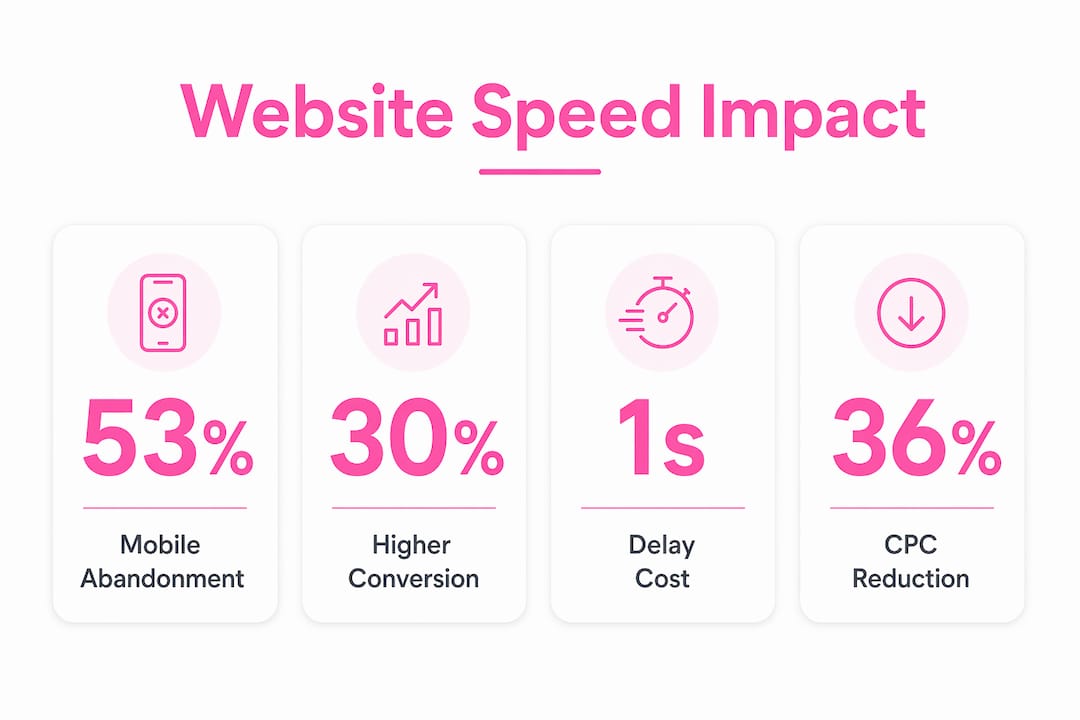
User patience online is short and non-negotiable. Research consistently shows that 53% of mobile users abandon a page that takes longer than 3 seconds to load. That means more than half your mobile audience never sees your offer if your site is slow.
The relationship between speed and conversions is not linear. The biggest behavioral impact happens in the 1–3 second window. Moving from a 5-second load to a 4-second load produces a smaller lift than moving from 3 seconds to 2 seconds. Website speed affects revenue exponentially in this critical range, which is why targeting sub-2-second load times delivers outsized returns.
Beyond bounce rates, speed shapes how deeply users engage with your site:
- Pages per session drop sharply when load times exceed 3 seconds
- Time on site falls as users grow impatient between page transitions
- Return visit rates decline when users associate your brand with slow performance
- Form completion rates suffer when checkout or lead forms lag
Shopify data confirms this pattern. Stores with faster Largest Contentful Paint (LCP) consistently show 30% higher conversion rates than slower stores. LCP measures how quickly the main visible content of a page loads. It is one of Google's Core Web Vitals and one of the most direct speed signals tied to revenue.
Why is website speed especially important for mobile users and ecommerce?
Mobile is where the speed problem is most severe and most costly. Mobile pages load 1.7 times slower than desktop on average, yet mobile accounts for 77% of ecommerce traffic. Despite driving the majority of visits, mobile converts at roughly half the rate of desktop. That gap is largely a speed problem.
The math here is stark. If you are running an ecommerce store and ignoring mobile load times, you are accepting a structural revenue penalty on your largest traffic source. Closing even a fraction of the mobile-to-desktop conversion gap through speed improvements can produce significant revenue lifts without increasing ad spend.
Pro Tip: Use Google PageSpeed Insights or WebPageTest to measure your mobile LCP and Time to First Byte (TTFB) separately from desktop. Mobile scores are almost always worse, and they are the ones costing you the most money.
Checkout speed deserves specific attention. Cart abandonment spikes when payment pages lag. A user who has already committed to buying will still leave if the confirmation step takes too long. Speed optimization at the checkout stage alone can recover a meaningful share of lost revenue. For ecommerce businesses, the importance of site speed is not a technical concern. It is a direct revenue lever.
How does website speed influence advertising costs and paid campaign efficiency?
Slow pages do not just cost you organic revenue. They make your paid campaigns more expensive. Google Ads assigns a Quality Score to every ad, and landing page experience is a core component of that score. A poor landing page experience, often caused by slow load times, raises your cost per click (CPC).
Ads linking to pages with above-average landing page experience have CPC rates 36% below average. That is not a marginal difference. It means a fast landing page can reduce what you pay for every click by more than a third, while simultaneously converting more of those clicks into customers.
The compounding effect here is significant. Consider this sequence:
- You improve page load time from 4 seconds to under 2 seconds
- Your Google Ads Quality Score improves due to better landing page experience
- Your CPC drops by up to 36%, giving your budget more reach
- Your conversion rate rises because users stay and complete purchases
- Your cost per acquisition (CPA) falls while revenue per campaign increases
Pro Tip: Run a speed audit on your top five paid landing pages before your next campaign. A 1-second improvement on a high-spend page can reduce monthly ad costs by hundreds or thousands of dollars depending on your budget.
This compounding effect is why speed optimization and ad efficiency belong in the same conversation. Marketers who treat them as separate disciplines leave significant budget savings on the table.
What nuances affect the speed-revenue relationship across business types?
Not every business sees the same return from speed improvements. The relationship between speed and revenue varies with store maturity, baseline performance, and traffic volume.
| Business type | Speed improvement impact | Key consideration |
|---|---|---|
| Small or growing store | Large percentage conversion gains | Even modest speed fixes produce visible revenue lifts |
| Mid-size ecommerce | Strong gains at checkout and mobile | Focus on LCP and mobile TTFB for fastest ROI |
| Mature enterprise brand | Smaller percentage gains, larger absolute revenue | 100ms improvements matter at scale, as Amazon data shows |
| B2B lead generation site | High impact on form completion and lead quality | Speed affects trust signals that influence B2B decisions |
According to Shopify's 2026 analysis, smaller stores experience larger percentage conversion uplifts from speed improvements, while mature brands see smaller percentage gains but larger absolute financial impact. This means speed optimization is worth pursuing at every stage, but the tactics and priorities differ.
Performance improvements have diminishing returns at the fast end of the spectrum. Moving from 5 seconds to 3 seconds delivers a much larger conversion lift than moving from 1.5 seconds to 0.8 seconds. This is useful for prioritization. If your site currently loads in 4 or more seconds, speed is your highest-ROI investment. If you are already under 2 seconds, the gains are real but smaller.
Product catalog size also matters. Larger catalogs with many images and dynamic filters create more render-blocking resources. Sites with hundreds of SKUs need more aggressive image compression, lazy-loading, and CDN configuration than a simple five-page service site.
What practical steps can business owners and marketers take to improve site speed?
Speed optimization follows a clear priority order. Start with the changes that produce the largest load time reductions, then move to refinements.
- Compress and properly size images. Unoptimized images are the most common cause of slow load times. Use WebP format and serve images at the dimensions they will actually display. Tools like Squoosh or Cloudinary automate this at scale.
- Eliminate render-blocking resources. JavaScript and CSS files that load before your page content delay the First Contentful Paint. Defer non-critical JavaScript and minify CSS files to reduce this delay.
- Use a content delivery network (CDN). A CDN like Cloudflare or Fastly serves your assets from servers geographically close to each visitor. This reduces latency for users far from your origin server.
- Optimize server response time (TTFB). A slow server adds delay before any content loads. Upgrade hosting if your TTFB consistently exceeds 200 milliseconds.
- Enable HTTP/2 or HTTP/3. These protocols allow multiple requests to load in parallel, reducing the sequential bottlenecks that slow older HTTP/1.1 connections.
Ongoing monitoring of Core Web Vitals is not optional. Speed gains erode over time as new content, plugins, and third-party scripts accumulate. Automated monitoring tools like Google Search Console, Calibre, or SpeedCurve track Core Web Vitals at key funnel points and alert you when performance degrades.
Pro Tip: Set up automated Core Web Vitals alerts on your checkout page specifically. That single page has the highest revenue impact per millisecond of improvement, and it is the most likely to degrade after platform updates.
A speed audit before any major site update or campaign launch catches performance regressions before they cost you money. Pair that with a website readiness checklist to confirm speed benchmarks are met at every deployment.
Key takeaways
Website speed directly controls conversion rates, user engagement, and advertising costs, making it one of the highest-ROI investments available to business owners and digital marketers.
| Point | Details |
|---|---|
| Speed and conversions are directly linked | Every 1-second delay reduces conversions by 7%, costing a $1M/month site $70,000 monthly. |
| Mobile is the biggest revenue gap | Mobile loads 1.7x slower than desktop but drives 77% of ecommerce traffic. |
| Faster pages lower ad costs | Above-average landing page experience reduces Google Ads CPC by up to 36%. |
| Gains are nonlinear | The biggest revenue lift comes from reducing load times within the 1–3 second window. |
| Speed requires ongoing maintenance | Core Web Vitals degrade with new content releases without regular monitoring and optimization. |
Speed is not a one-time fix. Here is what I have learned.
I have seen businesses invest in a speed overhaul, celebrate the results, and then watch their scores quietly decay over the next six months as new plugins, tracking scripts, and image uploads accumulate. The misconception is that speed is a project. It is not. It is an operational discipline.
The businesses that sustain revenue gains from speed are the ones that treat Core Web Vitals the same way they treat uptime. They monitor it continuously, they set thresholds, and they act when those thresholds are crossed. The ones that treat it as a one-time fix end up back where they started, usually right before a major campaign when the cost of slowness is highest.
There is also a common belief that speed optimization only matters for large ecommerce sites. That is wrong. A local service business with a slow contact page loses leads the same way a retailer loses cart completions. The scale differs. The mechanism is identical.
My honest recommendation: start with a speed audit for your site today, prioritize your highest-traffic pages, and build a monitoring routine before you touch anything else. The data will tell you exactly where your revenue is leaking.
— Ville
How Verkkosivu builds speed-optimized websites that protect your revenue
Every website Verkkosivu builds loads in under one second. That is not a feature. It is the baseline. Slow sites cost you money in conversions, ad spend, and search rankings, and Verkkosivu's custom-built approach eliminates the template bloat and unoptimized code that cause those losses.

With more than 100 successful projects and a perfect 5-star rating on Google, Verkkosivu delivers fully custom, speed-optimized websites, often within 48 hours, with no hidden costs. Every site includes SEO optimization, A/B testing capability, and ongoing maintenance to keep performance from degrading over time. If you are ready to stop losing revenue to a slow site, explore Verkkosivu's services and see what a sub-one-second website can do for your business.
FAQ
How much revenue does a slow website actually cost?
Every 1-second delay reduces conversions by roughly 7%. For a site earning $1 million per month, that translates to $70,000 in monthly lost sales from a single second of added load time.
Does website speed affect Google Ads costs?
Yes. Pages with above-average landing page experience, which is heavily influenced by speed, have CPC rates 36% lower than average. Faster pages directly reduce what you pay per click.
What is the most important speed metric for conversions?
Largest Contentful Paint (LCP) is the Core Web Vital most directly tied to conversion rates. Stores with faster LCP consistently show 30% higher conversion rates than slower competitors.
How fast should a website load to avoid revenue loss?
Aim for a load time under 2 seconds. The 1–3 second window is where the largest behavioral drop-offs occur, and getting below 2 seconds captures the majority of the available conversion uplift.
How often should I check my website's speed?
Speed should be monitored continuously using automated tools. Core Web Vitals degrade with every new content release, plugin update, or third-party script addition, making ongoing monitoring a revenue protection requirement, not a one-time task.