
SEO is the process of making your website discoverable, readable, and rankable by search engines from the moment it goes live. The role of SEO in website launch is not a post-launch task. It is the foundation your site's visibility is built on. 93% of online experiences start with a search engine, which means your site either shows up or it doesn't. Ignoring SEO at launch delays meaningful traffic by 3–6 months, and that delay costs real revenue.
What are the key SEO technical foundations for a website launch?
Technical SEO is the set of behind-the-scenes configurations that tell search engines how to crawl, index, and rank your site. Get these wrong at launch and you are invisible, regardless of how good your content is.
76% of websites audited have common SEO errors that cause significant traffic loss. That number means most sites launch with problems already baked in. The good news is that most of these errors are preventable with a pre-launch checklist.
Here are the technical SEO elements every site must address before going live:
- No-index tags: Staging environments use no-index tags to block search engines during development. Leaving this tag active on your production site makes it invisible to Google for weeks. Check your robots.txt and meta tags before launch.
- SSL certificate: Google treats HTTPS as a ranking signal. A site without SSL shows a "Not Secure" warning in browsers, which kills trust and conversions.
- Mobile responsiveness: Google uses mobile-first indexing, meaning it crawls the mobile version of your site first. A desktop-only design will rank poorly.
- Page speed: Every 100ms page load delay reduces conversion rates by approximately 7%. Speed is not a nice-to-have. It is a direct revenue factor.
- Redirect mapping: If you are replacing an existing site, map every old URL to its new equivalent. Failing to implement redirects causes 30–50% traffic drops within the first two weeks post-launch.
- XML sitemap: Submit a sitemap to Google Search Console so search engines know exactly which pages to crawl.
Pro Tip: Run a crawl of your staging site using a tool like Screaming Frog before you flip the live switch. Fix broken links, duplicate titles, and missing meta descriptions before they ever reach Google.
The load speed connection to SEO is especially direct. Sites that load in under one second rank higher and convert better. Build speed into your architecture from day one, not as a fix after launch.

How does content and site architecture influence SEO at launch?
Content quality and site structure are the two factors that determine whether Google sees your site as trustworthy or thin. Both must be ready before you publish.
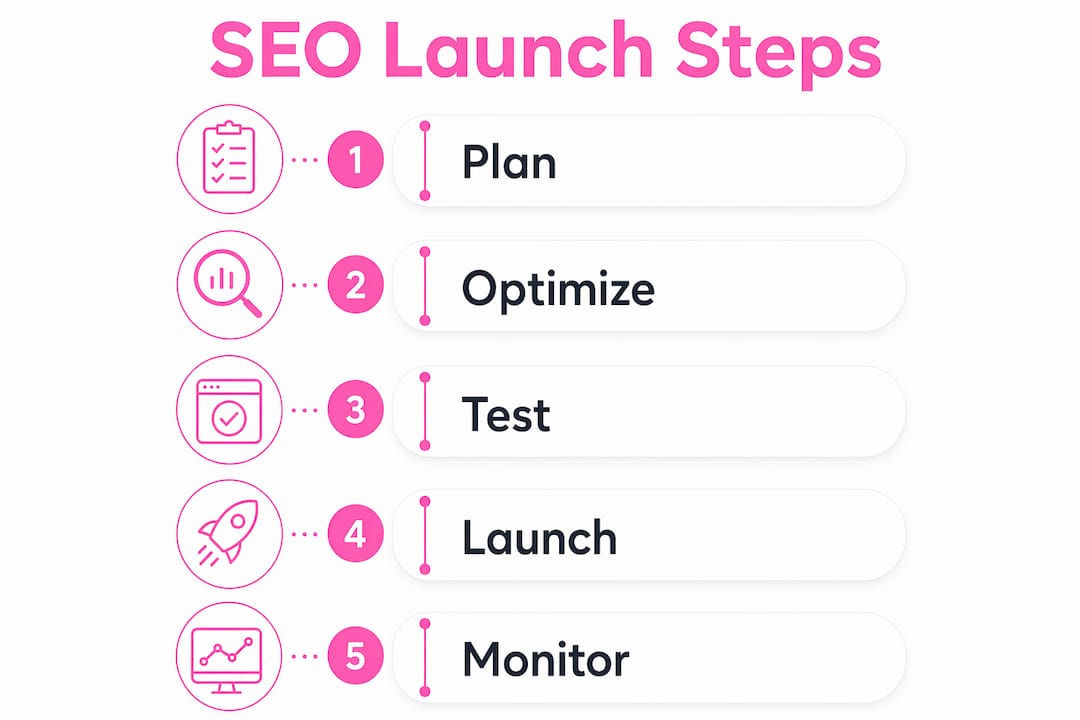
Search engines evaluate content quality at the page level and the site level. Publishing pages with placeholder text harms domain trust and initial ranking potential. Google interprets placeholder content as low quality, and that judgment sticks. Launch only with complete, substantive pages.
A clear site architecture does three things: it helps users navigate, it helps search engines crawl, and it distributes link authority across your pages. Here is how to build it correctly from the start:
- Define your pillar pages first. A pillar page covers a broad topic in depth. Your homepage, main service pages, and core product pages are your pillars. Every other page should link back to at least one of them.
- Build topical clusters around each pillar. A cluster is a group of related pages that support the pillar topic. For example, a pillar page on "web design" might link to cluster pages on "web design for restaurants," "web design pricing," and "web design timelines."
- Create a logical URL structure. URLs should reflect your site hierarchy. Use short, descriptive slugs. Avoid auto-generated strings of numbers or symbols.
- Link related pages internally from day one. Internal links pass authority between pages and help Google understand your site's topic map. Connect service pages to relevant blog posts and vice versa.
- Launch with a minimum viable site of complete content. A smaller site with five fully developed pages outperforms a large site with twenty thin ones. Quality beats quantity at launch.
The website readiness checklist for small businesses covers both content and technical requirements in detail. Use it as a cross-reference before you publish.
What SEO strategies accelerate indexing and domain authority after launch?
Getting your site indexed quickly is the first post-launch priority. Indexing means Google has found, crawled, and added your pages to its database. Until that happens, you do not exist in search results.
Google Search Console is the primary tool for accelerating this process. Submit your XML sitemap through Search Console on launch day. Then use the URL Inspection tool to request indexing for your most important pages individually. Google typically processes these requests within a few days.
- Submit your sitemap immediately. Go to Google Search Console, navigate to Sitemaps, and submit your sitemap URL. This tells Google exactly which pages to crawl.
- Request indexing for priority pages. Use the URL Inspection tool to manually request indexing for your homepage, service pages, and any high-value content.
- Build initial trust signals. Directory listings and social profiles help new domains exit Google's sandbox phase faster. Submit your business to Google Business Profile, Bing Places, and relevant industry directories.
- Monitor Search Console weekly. Check for crawl errors, coverage issues, and manual actions. Catching a problem in week one is far cheaper than fixing it in month three.
Pro Tip: Set up Google Search Console and Google Analytics before launch, not after. You want baseline data from day one so you can measure what changes after you go live.
Search engines need 3–6 months to display meaningful rankings for new sites. That timeline is not a failure. It is how organic search works. If you need traffic immediately, paid search fills the gap while your organic rankings build.
What are the most common SEO launch mistakes?
Most SEO launch failures come from a short list of predictable errors. Knowing them in advance is the entire defense.
| Mistake | Impact | Prevention |
|---|---|---|
| No-index tag left active | Site invisible to Google for weeks | Audit robots.txt and meta tags before going live |
| No redirect map | 30–50% traffic drop in two weeks | Map every old URL to its new equivalent before launch |
| Placeholder content published | Domain trust score damaged | Launch only with complete, final copy on every page |
| No SSL certificate | Browser warnings, ranking penalty | Install SSL before launch day |
| Ignoring mobile responsiveness | Poor rankings due to mobile-first indexing | Test on multiple devices and screen sizes pre-launch |
| Skipping Google Search Console setup | Delayed indexing, missed crawl errors | Set up Search Console before launch |
Google's 2024 core update made site-wide quality evaluation more critical. A weak foundation at launch now affects every page on the site, not just the ones with obvious problems. One thin page or one technical error can suppress rankings across your entire domain.
Retrofitting SEO into a finished website means making compromises that harm rankings and require costly fixes over time. The cost of fixing SEO problems after launch is consistently higher than building them correctly from the start. Treat your pre-launch SEO checklist as non-negotiable, not optional.
Key Takeaways
SEO built into a website before launch produces faster indexing, stronger rankings, and measurably fewer traffic losses than SEO applied as a post-launch fix.
| Point | Details |
|---|---|
| SEO starts before launch | Technical SEO, content, and site structure must be ready on day one, not added later. |
| Technical errors are common | 76% of audited sites have SEO errors; check no-index tags, speed, SSL, and redirects before going live. |
| Content quality matters immediately | Placeholder or thin content damages domain trust from the first crawl. |
| Indexing requires active steps | Submit your sitemap and use Google Search Console on launch day to accelerate indexing. |
| Results take time | Organic rankings typically take 3–6 months; plan for paid traffic to bridge the gap. |
SEO at launch is architecture, not decoration
Every website I have seen struggle with organic traffic shares one trait: SEO was treated as something to add after the site looked good. That thinking is backwards, and it is expensive.
SEO integrated as foundational architecture from the start produces measurably better outcomes than retrofitting it later. The sites I have watched rank quickly all had one thing in common: the developer and the SEO plan were working in parallel, not in sequence. The technical setup, the URL structure, the content plan, and the internal linking were all decided before a single page went live.
The 3–6 month timeline for organic rankings is real, but it is not fixed. Sites that launch with clean technical SEO, complete content, and an active Search Console setup consistently reach meaningful rankings faster than sites that launch and then scramble to fix problems. The difference is not luck. It is preparation.
My honest advice: treat your pre-launch SEO checklist the same way you treat your legal and financial setup. You would not open a business without a bank account. Do not launch a website without confirming your indexing is enabled, your redirects are mapped, and your content is complete. The cost of skipping these steps is always higher than the cost of doing them right the first time.
— Ville
Verkkosivu builds websites that are SEO-ready from day one
Every website Verkkosivu builds is designed to rank, not just to look good. Technical SEO, page speed under one second, mobile responsiveness, and clean site architecture are built into every project from the initial consultation.

Verkkosivu has completed more than 100 custom website projects with a perfect 5-star rating on Google. Every site is built without templates, tailored to your brand, and delivered with full SEO foundations in place. If you are planning a launch and want to avoid the costly mistakes covered in this guide, see how Verkkosivu works and get your site built right the first time.
FAQ
What is the role of SEO in a website launch?
SEO ensures your site is discoverable, crawlable, and rankable by search engines from day one. Without it, your site can remain invisible in search results for months.
How long does SEO take to show results after launch?
Search engines typically need 3–6 months to display meaningful rankings for new sites. Paid advertising covers traffic needs while organic rankings build.
What is the most critical technical SEO mistake at launch?
Leaving the no-index tag active from your staging environment is the most common fatal error. It blocks Google from indexing your site entirely until the tag is removed.
Why does page speed matter for SEO at launch?
Every 100ms page load delay reduces conversion rates by approximately 7%. Google also uses page speed as a direct ranking factor, so slow sites rank lower and convert less.
Do I need Google Search Console before my site launches?
Yes. Setting up Google Search Console before launch lets you submit your sitemap, request indexing, and monitor crawl errors from day one rather than discovering problems weeks later.