
Website load speed is a direct ranking signal, a conversion driver, and a user trust factor that no digital marketer or website owner can afford to ignore. Google's Core Web Vitals, first introduced as ranking signals in 2021 and given increased weight in a March 2026 core update, make page performance a measurable SEO requirement. Sites loading under 2 seconds achieve 2.4x higher conversions than those taking over 5 seconds. Understanding why website load speed matters starts with knowing exactly what it measures and what it costs you when it falls short.
Why website load speed matters for SEO rankings
Page speed is no longer a secondary SEO consideration. Google's algorithm now treats Core Web Vitals as primary ranking signals, and the 2026 update intensified that weighting. The three metrics at the center of this are Largest Contentful Paint (LCP), Interaction to Next Paint (INP), and Cumulative Layout Shift (CLS). Each one measures a distinct dimension of how fast and stable a page feels to a real user.
The competitive gap is significant. Only 42% of mobile sites pass all Core Web Vitals thresholds, which means more than half of mobile pages are actively disadvantaged in Google's mobile-first index. If your site is in that majority, you are conceding ranking positions to competitors who have done the optimization work.
Speed also determines how efficiently Google crawls your site. Sites with TTFB under 200ms have 2.1x more indexed pages than those with TTFB above 1 second. More indexed pages means more organic entry points, which compounds your SEO advantage over time.

The emerging factor most marketers are not yet tracking is Generative Engine Optimization (GEO). AI search engines like ChatGPT and Perplexity deprioritize slow or error-prone sources when selecting content to cite in generated answers. Speed is now a prerequisite for AI search visibility, not just traditional Google rankings. This makes performance optimization a forward-looking investment, not just a technical checkbox.
Key SEO impacts of load speed at a glance:
- Core Web Vitals are official Google ranking signals with increased weight since March 2026
- INP replaced FID as the interactivity metric, raising the bar for responsiveness
- Mobile-first indexing penalizes sites that fail mobile Core Web Vitals thresholds
- Crawl budget expands with faster TTFB, leading to deeper and more frequent indexation
- GEO eligibility requires fast, reliable pages for AI citation selection
How load speed affects user experience and conversions
User patience online is measurable and short. 53% of mobile visitors abandon a site that takes more than 3 seconds to load. That is not a soft behavioral tendency. It is a hard exit rate that directly reduces the pool of users who ever see your content, your offer, or your call to action.
The financial impact scales with every second of delay. Each additional second of load time costs roughly 7% in conversion rate. For an e-commerce site generating $50,000 per month, a 2-second delay translates to roughly $7,000 in lost monthly revenue. The math is straightforward and the implication is clear: speed is a revenue variable, not just a technical metric.
"Speed is the digital brand's first impression; users equate fast sites with professionalism and security, while slow sites damage credibility instantly." — Business.com
The loyalty damage from slow sites compounds over time. Each one-second delay reduces user satisfaction by about 16%, and 79% of shoppers who experience a slow site say they will not return. Acquiring a new customer costs significantly more than retaining an existing one, so every slow-load experience is a retention failure with a real cost attached.
The behavioral pattern breaks down like this:
- Under 1 second: Users perceive the site as instant. Trust and engagement are high.
- 1 to 3 seconds: Satisfaction begins to decline. Bounce probability rises steadily.
- 3 to 5 seconds: More than half of mobile users have already left.
- Over 5 seconds: Conversion rates drop to less than half of what a sub-2-second site achieves.
Brand perception is also at stake. Users cannot see your server infrastructure or your code quality, but they feel the speed. A slow site signals poor investment in user experience, which users interpret as a reflection of how you treat customers generally. Improving site load time is one of the highest-return investments a website owner can make.
Which speed metrics matter most and how they compare
The three Core Web Vitals each measure something distinct, and failing any one of them affects your ranking. Understanding the thresholds helps you prioritize where to focus your optimization effort.
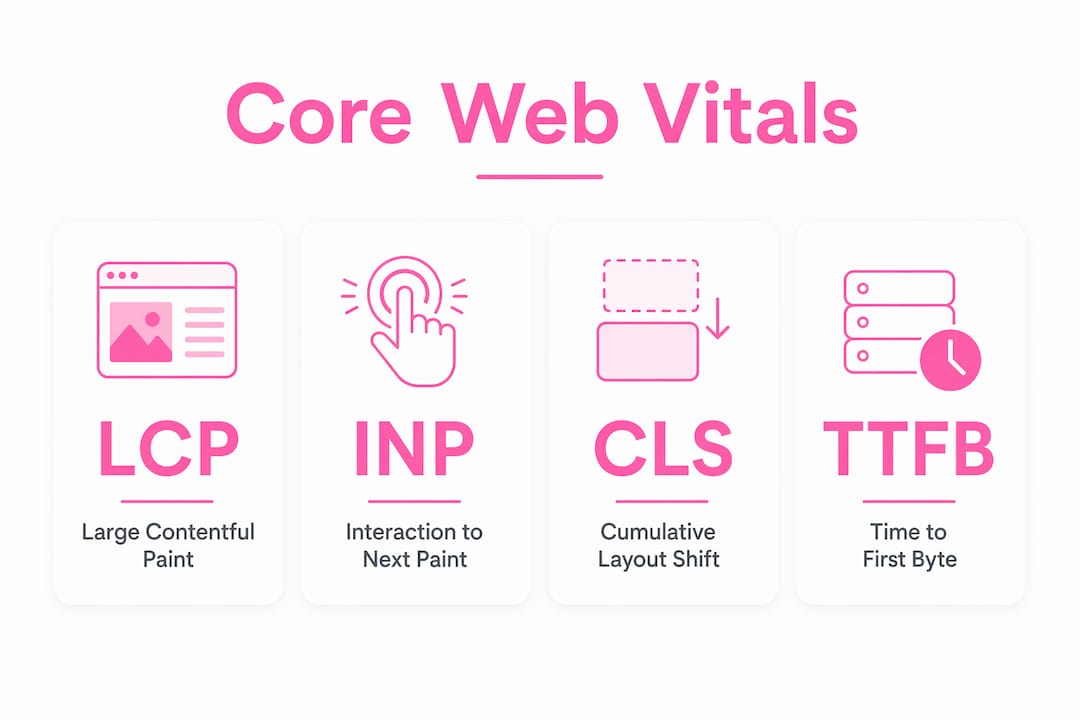
| Metric | What it measures | Good threshold | Common failure cause |
|---|---|---|---|
| LCP (Largest Contentful Paint) | Time to render the largest visible element | Under 2.5 seconds | Unoptimized images, slow server response |
| INP (Interaction to Next Paint) | Responsiveness to user interactions | Under 200ms | JavaScript blocking the main thread |
| CLS (Cumulative Layout Shift) | Visual stability during load | Under 0.1 | Images without dimensions, late-loading fonts |
| TTFB (Time to First Byte) | Server response time | Under 200ms | Slow hosting, no CDN, unoptimized backend |
LCP is the most visible metric because it measures when the page looks loaded to the user. Slow LCP is almost always caused by large, unoptimized images or a slow server response. INP is the hardest to fix because it requires changes to JavaScript execution patterns, not just asset sizes. CLS is often overlooked but causes the jarring layout shifts users notice when a page rearranges itself mid-scroll.
TTFB sits upstream of all three. A slow server response delays every subsequent metric, so improving hosting quality or adding a CDN often produces the fastest across-the-board gains. Choosing the right platform for your business website has a direct impact on your baseline TTFB before any other optimization is applied.
Pro Tip: To improve INP, break long JavaScript tasks into smaller chunks and yield to the main thread between them. Tasks over 50ms block user interactions and push INP above the 200ms threshold. Tools like Chrome DevTools' Performance panel show exactly which tasks are causing delays.
What practical steps improve site load time
Optimization is not a one-time project. Performance work must be continuous and embedded in your broader conversion rate optimization (CRO) strategy to sustain gains and translate them into revenue. Here is where to start and what to prioritize.
-
Optimize images first. Images are the largest assets on most pages. Compress them using modern formats like WebP or AVIF, set explicit width and height attributes to prevent CLS, and implement lazy-loading for images below the fold. This single step often produces the largest LCP improvement.
-
Deploy a CDN. A content delivery network reduces average page load times by over 50% and is used by 71% of top websites. CDNs serve assets from edge servers close to the user, cutting the physical distance data must travel. For any site with a geographically distributed audience, a CDN is non-negotiable.
-
Reduce JavaScript bloat. The average website ships nearly 500KB of JavaScript, making JS the number one performance bottleneck. Audit your scripts, remove unused libraries, minify and compress what remains, and defer non-critical scripts so they do not block initial rendering.
-
Implement caching. Browser caching stores static assets locally on the user's device after the first visit. Server-side caching reduces database queries on repeat requests. Both reduce load times for returning visitors and lower server load simultaneously.
-
Upgrade your hosting. Shared hosting plans frequently produce TTFB above 1 second. Moving to a managed hosting provider with HTTP/2 support, SSD storage, and server-side caching built in can cut TTFB by 60% to 80% without changing a single line of code.
-
Monitor continuously. Use Google Search Console's Core Web Vitals report, PageSpeed Insights, and Lighthouse to track real-user data over time. Every 500ms latency reduction correlates to measurable revenue gains, so ongoing monitoring lets you quantify the return on each optimization cycle.
Pro Tip: Run PageSpeed Insights on your three highest-traffic pages first, not your homepage. Those pages carry the most conversion weight and often have the most optimization opportunity.
Key takeaways
Website load speed directly determines your Google rankings, your conversion rates, and your visibility in AI-generated search results, making it one of the highest-leverage technical investments available to any website owner.
| Point | Details |
|---|---|
| Speed is a ranking signal | Core Web Vitals are official Google ranking factors with increased weight since March 2026. |
| Conversions drop per second | Each additional second of load time costs roughly 7% in conversion rate. |
| Mobile performance gap | Only 42% of mobile sites pass all Core Web Vitals, creating a clear competitive advantage for optimized sites. |
| AI search requires speed | ChatGPT and Perplexity deprioritize slow sources, making speed critical for GEO visibility. |
| Optimization must be continuous | Embedding performance work into CRO cycles sustains revenue gains over time. |
Speed is the foundation, not a feature
I have worked with dozens of websites where the conversation starts with design or content, and speed gets treated as a final checklist item. That is the wrong order. After seeing how Core Web Vitals directly shift ranking positions within weeks of improvement, I am convinced that performance is the foundation everything else sits on.
The metric most teams underestimate is INP. Everyone talks about LCP because it is visible and intuitive. But INP measures how your site responds when a user clicks a button or opens a menu, and failing it means your site feels sluggish even when it looks fast. I have seen sites with excellent LCP scores lose conversions because their JavaScript-heavy interfaces felt unresponsive. Fixing INP often requires rethinking how JavaScript is structured, not just compressed.
The other mistake I see repeatedly is treating speed optimization as a one-time sprint. You fix the obvious issues, scores improve, and then six months later a new plugin, a third-party script, or a new image-heavy campaign has undone the gains. Performance degrades silently. The teams that win are the ones who treat speed the same way they treat security: as an ongoing operational responsibility with regular audits and clear ownership.
Mobile speed deserves special attention. The majority of web traffic is mobile, yet mobile Core Web Vitals pass rates are significantly lower than desktop. If your optimization work has focused on desktop scores, you are likely leaving your largest audience segment with a degraded experience and conceding mobile rankings to competitors who have addressed it.
Speed is not a technical nicety. It is a direct input to revenue, rankings, and brand trust. Treat it accordingly.
— Ville
How Verkkosivu builds speed into every website

Verkkosivu specializes in custom websites that load in under one second, built without templates and optimized from the ground up for Core Web Vitals performance. Every project includes SEO optimization, A/B testing capability, and ongoing maintenance so your speed scores do not degrade after launch. With more than 100 completed projects and a perfect 5-star Google rating, Verkkosivu delivers measurable performance results, typically within 48 hours of project start. If your current site is losing rankings or conversions to slow load times, see what a performance-first website built by Verkkosivu looks like in practice.
FAQ
Why does website load speed affect Google rankings?
Google uses Core Web Vitals (LCP, INP, and CLS) as direct ranking signals, with increased weighting applied in the March 2026 core update. Sites that fail these thresholds are ranked lower, particularly in mobile-first indexing.
How much does a slow site hurt conversion rates?
Each additional second of load time costs roughly 7% in conversion rate, and sites loading over 5 seconds convert at less than half the rate of sites loading under 2 seconds.
What is a good page load time in 2026?
A good LCP is under 2.5 seconds, INP under 200ms, and CLS under 0.1. TTFB should be under 200ms. Hitting all four thresholds qualifies a page as passing Core Web Vitals.
Does load speed affect AI search results?
Yes. AI search engines like ChatGPT and Perplexity deprioritize slow or error-prone sources when selecting content to cite. Speed is a prerequisite for visibility in generative search, a practice known as Generative Engine Optimization (GEO).
What is the fastest way to improve page load time?
Deploying a CDN reduces load times by over 50% for most sites and is the single highest-impact change for geographically distributed audiences. Combining CDN deployment with image optimization and JavaScript reduction addresses the three most common performance bottlenecks simultaneously.