
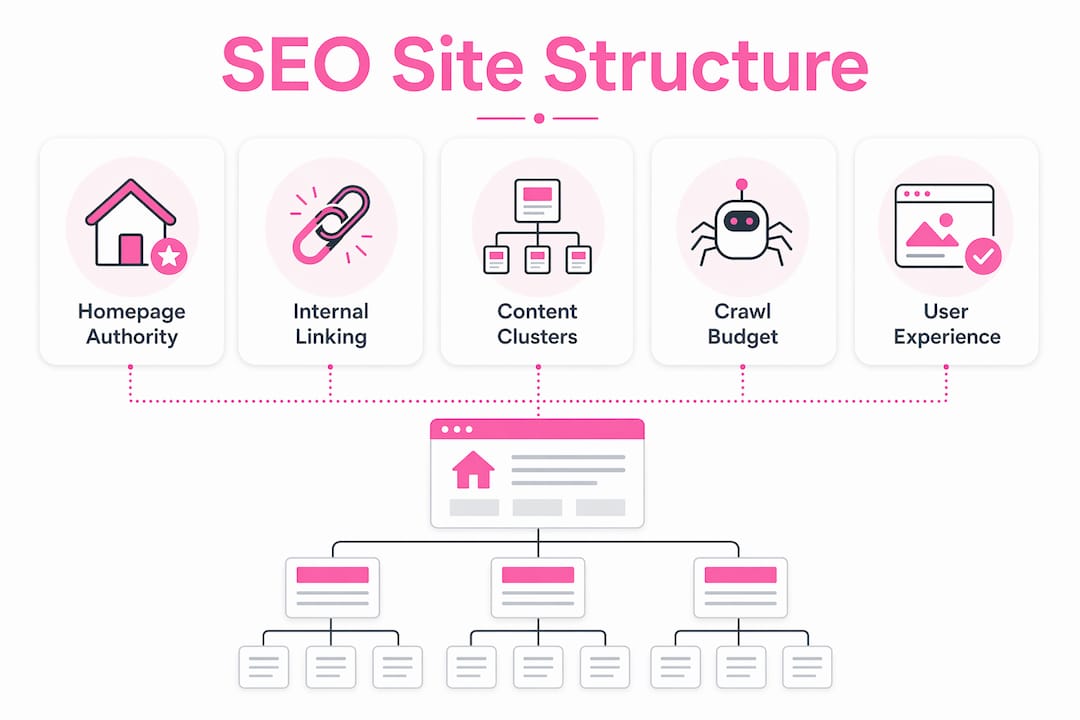
Website structure is defined as the organization and internal linking of a site's pages that determines how search engines crawl, index, and rank your content. This is the core reason why website structure affects SEO at every level, from Googlebot's first visit to a user's final click. Poor structure buries pages, wastes crawl budget, and scatters link equity. A well-planned site architecture, by contrast, sends clear signals about which pages matter most and how topics relate. This guide breaks down exactly how site layout, internal linking, and content grouping combine to drive or damage your organic visibility.
Why website structure affects SEO: crawling and indexing
Search engine crawling is the first place where site structure creates a measurable advantage or a serious problem. Googlebot discovers pages primarily by following internal links, which means pages buried deep in your hierarchy or completely disconnected from other pages receive far less crawl attention. Less crawl attention means slower indexing and weaker ranking signals.
Crawl budget is the number of pages Googlebot will crawl on your site within a given time window. Large sites with thousands of pages feel this constraint most sharply, but even mid-sized sites waste budget through poor structure. Deep site structures and duplicate faceted pages consume crawl budget and delay Google's discovery of your most important pages.
A flat site structure solves this directly. In a flat structure, every page sits within two or three clicks of the homepage. In a deep structure, important product or service pages can sit six or seven levels down, making them hard for Googlebot to reach consistently. The practical difference shows up in how quickly new content gets indexed and how reliably key pages appear in search results.
Here are the structural factors that most directly affect crawl efficiency:
- Orphaned pages: Pages with no internal links pointing to them. Googlebot cannot find them through crawling alone.
- Redirect chains: Multiple consecutive redirects slow crawl speed and dilute link signals before Googlebot reaches the final URL.
- Parameter-driven duplicate URLs: Faceted navigation that generates thousands of near-identical URLs wastes crawl budget on pages that should never be indexed.
- XML sitemaps: Submitting a clean sitemap in Google Search Console helps Googlebot discover pages that internal links may miss, but sitemaps work best as a backup, not a substitute for good internal linking.
Pro Tip: Use Google Search Console's Crawl Stats report alongside server log analysis to confirm whether your priority URLs are being discovered through internal links or only through sitemap submissions. If Googlebot relies entirely on your sitemap for key pages, your internal link structure needs work.
How does internal linking distribute link equity across your site?
Internal linking is the mechanism by which link equity, sometimes called PageRank, flows from authoritative pages to supporting pages. Internal linking distributes link equity across your site, and pages linked from high-authority sources like the homepage receive more ranking power as a direct result. This is why your homepage is not just a welcome screen. It is your most powerful SEO asset.

The homepage holds the highest authority on any site. Every internal link it points to passes a share of that authority to the destination page. Reducing the number of links on the homepage increases the equity passed per link, which means a cluttered navigation menu with 40 links actually dilutes the value sent to each destination. Fewer, more deliberate links from the homepage concentrate authority where it matters most.
Link placement within a page also changes the strength of the signal. Links within page content carry stronger relevance signals than primary navigation links because the surrounding text adds topical context. A link to your pricing page placed inside a paragraph about service benefits tells Google more than the same link sitting in a footer menu.
The table below shows the difference between structured and poor internal linking in practice:
| Factor | Structured internal linking | Poor internal linking |
|---|---|---|
| Link equity flow | Concentrated on priority pages | Scattered across low-value pages |
| Anchor text | Descriptive and contextual | Generic ("click here", "read more") |
| Page depth | Key pages within 2–3 clicks | Key pages buried 5+ clicks deep |
| Orphaned pages | None | Common, especially for older content |
| Crawl efficiency | High, Googlebot reaches all key pages | Low, important pages missed or delayed |
Pro Tip: Audit your internal links with a tool like Screaming Frog or Sitebulb. Filter for pages that receive zero internal links and for pages that receive the most. The distribution will almost always reveal that your most commercially important pages are underpowered compared to blog posts or category pages.
How do content clusters strengthen topical relevance for SEO?
Topical content clusters are the most direct way to signal expertise to Google. A cluster consists of a hub page, sometimes called a pillar page, that covers a broad topic, and a set of supporting pages that each address a specific subtopic. Topical content clusters using hub-and-spoke linking improve search engines' understanding of site topics and strengthen relevance signals across the entire cluster.
The linking pattern inside a cluster matters as much as the content itself. Supporting pages link back to the hub, and the hub links out to each supporting page. This creates a closed loop of contextual links that reinforces the semantic relationship between pages. Google infers topical authority from this pattern, which is why a well-structured cluster on a single topic can outrank a site with more total content but no coherent structure.
Breadcrumbs play a supporting role here that most site owners underestimate. Breadcrumb navigation provides crawlable internal links that reflect site hierarchy, improving both link equity flow and user orientation on deep pages. A breadcrumb trail on a product page that reads Home > Category > Subcategory > Product passes anchor text signals up the hierarchy on every page load.
Practical signs of an effective cluster structure include:
- A hub page that ranks for broad, high-volume terms in its topic area
- Supporting pages that rank for specific long-tail variations of the same topic
- Consistent internal linking between hub and spokes with descriptive anchor text
- Breadcrumbs on every page below the homepage level
- No duplicate or near-duplicate pages competing for the same keyword within the cluster
Scattered content, by contrast, produces the opposite result. When related pages exist on a site but share no internal links, Google treats them as isolated documents rather than evidence of expertise. The importance of website architecture lies precisely in this: structure tells Google what your site is about, not just what each individual page says.
Does website structure affect user experience and SEO together?
Good site structure improves user experience by reducing the number of clicks required to reach any piece of content. Sites where users find content faster also tend to have better search performance. The connection is direct: lower bounce rates, longer session durations, and higher pages-per-session are all engagement signals that correlate with stronger rankings.
Navigation design is the most visible part of site structure for users. A clear top-level menu with logical categories lets visitors self-direct without confusion. When users cannot find what they need within two or three clicks, they leave. That exit sends a negative engagement signal back to Google, which factors user behavior into its ranking assessments over time.
Mobile responsiveness and page load speed are also structural concerns. A performance audit of your site often reveals that structural issues, such as deeply nested pages or bloated navigation menus, contribute directly to slow load times on mobile. Verkkosivu builds every site to load in under one second, which addresses both the technical and structural sides of this problem simultaneously.
UX best practices that align directly with SEO goals include:
- Limit navigation depth: Keep all key pages within three clicks of the homepage.
- Use descriptive menu labels: Vague labels like "Services" tell users and search engines less than "SEO Consulting" or "Web Design."
- Add breadcrumbs on all interior pages: They orient users and pass structured link signals up the hierarchy.
- Avoid duplicate navigation paths: Multiple routes to the same page can dilute link equity and confuse crawlers.
- Test on mobile first: Navigation that works on desktop often breaks on mobile, increasing bounce rates and reducing crawl efficiency.
Navigation structure and internal link consistency matter more than isolated landing page optimizations because they create stable crawl and equity pathways across the entire site.
Key Takeaways
Website structure controls how search engines crawl, index, and rank your pages, making it the single most foundational factor in long-term SEO performance.
| Point | Details |
|---|---|
| Crawl budget management | Keep key pages within 2–3 clicks of the homepage to maximize Googlebot's discovery rate. |
| Internal link equity | Concentrate homepage links on priority pages to pass maximum authority where it counts. |
| Content clusters | Group related pages with hub-and-spoke linking to signal topical expertise to Google. |
| Breadcrumb navigation | Add breadcrumbs on all interior pages to reinforce hierarchy and improve link equity flow. |
| UX and engagement | Faster content discovery reduces bounce rate, which correlates with stronger organic rankings. |
Structure first, metadata second
Most site owners I work with arrive focused on title tags, meta descriptions, and keyword density. Those elements matter, but they sit on top of a foundation that either supports or undermines everything else. Technical SEO improvements focused solely on metadata tweaks miss the root cause when site structure and UX signals are poor. I have seen sites with near-perfect on-page SEO stall in rankings for months, only to jump after a structural overhaul that flattened the hierarchy and rebuilt internal linking.
The mistake I see most often is treating site structure as a one-time setup decision. Structure needs to be audited regularly, especially after adding new content sections, running site migrations, or expanding into new topic areas. A site that had clean architecture at launch can develop orphaned pages, broken internal links, and crawl waste within a year of active publishing if no one is monitoring it.
My practical recommendation: run a website readiness check at least twice a year. Combine Google Search Console's Crawl Stats with a crawl tool to map your internal link graph. Identify which pages receive zero internal links and which pages are more than four clicks from the homepage. Fix those two issues before touching anything else, and you will see measurable ranking improvements within a few months.
Structure is not glamorous work. It does not produce the immediate visual feedback that a redesign does. But it is the work that compounds. Every new page you publish lands in a stronger position when the structure underneath it is clean.
— Ville
How Verkkosivu builds SEO-ready site architecture from day one
Verkkosivu approaches every project with site architecture as a primary deliverable, not an afterthought. Every site Verkkosivu builds is custom, loads in under one second, and is organized around a flat hierarchy that keeps key pages within three clicks of the homepage.
Verkkosivu's process includes internal linking planning, breadcrumb implementation, and navigation design that aligns with both SEO goals and user behavior. The team handles everything from initial structure planning through deployment, with no templates and no hidden costs. For businesses that want a professionally built website that ranks and converts from launch, Verkkosivu delivers results within 48 hours. With more than 100 completed projects and a perfect 5-star rating on Google, the track record speaks directly to what structured, well-built sites can achieve.
FAQ
Why does site structure matter for SEO?
Site structure determines how Googlebot crawls and indexes your pages, how link equity flows between them, and how users navigate your content. All three factors directly influence organic rankings.
What is crawl budget and how does structure affect it?
Crawl budget is the number of pages Googlebot will crawl on your site in a given period. A flat, well-linked structure helps Googlebot reach important pages faster, while deep or duplicate-heavy structures waste that budget on low-value URLs.
How do content clusters improve search rankings?
Content clusters group related pages with hub-and-spoke internal linking, which signals topical expertise to Google. Pages within a well-structured cluster tend to rank for a broader range of related queries than isolated pages do.
What is the difference between a flat and a deep site structure?
A flat structure keeps all pages within two or three clicks of the homepage, making them easy for both users and Googlebot to reach. A deep structure buries pages five or more levels down, reducing crawl frequency and link equity flow to those pages.
How does internal linking affect page rankings?
Internal links pass link equity from authoritative pages to linked pages. Pages that receive more internal links from high-authority sources, such as the homepage or category hubs, accumulate more ranking power than pages with few or no internal links pointing to them.