
A professional web presence is defined as the complete set of owned digital assets, primarily a custom website, that establishes a business's credibility and visibility online. For small business owners, this is not optional. Over 50% of website traffic arrives through organic search, meaning customers find you through Google before they ever hear your name from a friend. That single fact explains why professional web presence matters more than any other marketing investment you can make. Verkkosivu builds sites that load in under one second, rank in search, and convert visitors into paying customers. The gap between a professional site and a template-built page is the gap between being found and being invisible.
What key benefits does a professional web presence offer?
A professional website establishes credibility before a customer speaks to you. 77% of consumers research brands online before buying, and they judge your business by what they see in the first few seconds. A polished, fast site signals that you take your business seriously. A broken or outdated one signals the opposite.
The benefits of a professional website extend well beyond first impressions:
- Credibility and trust. A custom-designed site with clear branding, professional photography, and consistent messaging tells visitors you are a legitimate business worth their money.
- Search engine visibility. A site built with technical SEO compliance ranks higher in Google. Higher rankings mean more organic traffic without paying for ads.
- Customer engagement. Professional, intuitive design increases customer engagement by up to 50% compared to non-professional sites. Engaged visitors stay longer and buy more.
- Brand identity. A custom site reflects your specific brand, not a generic template that looks identical to your competitor's page.
- Conversion rates. Good user experience directly drives sales. A visitor who can find what they need quickly is far more likely to contact you or place an order.
- Competitive differentiation. Most small businesses in your market have weak or outdated websites. A professional site immediately sets you apart.
Pro Tip: Audit your current site against these six points. If you score below four, you are actively losing customers to competitors with stronger digital identities.
The importance of online presence compounds over time. A site that ranks well today will generate traffic for years. A site that never ranked will cost you in paid ads indefinitely.
How does professional web design influence customer trust?
Design is not decoration. 58% of online users prefer content that is beautifully designed, and that preference directly shapes whether they trust your business enough to buy. First impressions form in milliseconds, and design is the primary driver of those impressions.

Custom professional design and template-based sites differ in three measurable ways:
| Factor | Custom professional design | Template-based site |
|---|---|---|
| Mobile responsiveness | Built specifically for your content and audience | Generic breakpoints, often inconsistent |
| Technical SEO | Structured for crawlability and speed from the start | SEO often bolted on after the fact |
| Brand alignment | Every element reflects your specific identity | Shared visual language with thousands of other sites |
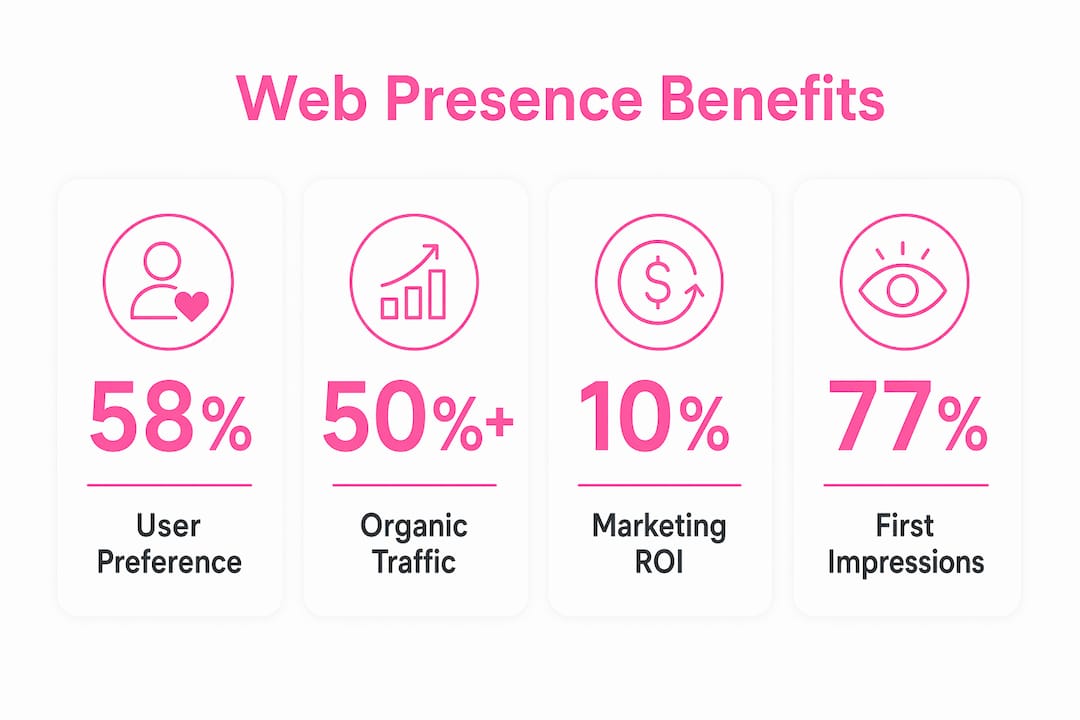
The business case for investing in design is concrete. Investing 10% of your marketing budget in UX design can yield an 83% conversion uplift. That is not an aesthetic argument. That is a revenue argument. Good user experience is a measurable growth driver, not a luxury.
Professional web design also ensures mobile optimization, technical SEO compliance, and security best practices from day one. Working with experienced designers saves time, reduces costly errors, and produces a site that performs under real traffic conditions.
Pro Tip: Before hiring any web designer, ask to see their Google PageSpeed scores for recent client sites. A score below 90 on mobile is a red flag.
Why does managing your online presence go beyond having a website?
A website is the foundation, but it is not the whole structure. Digital marketing experts describe the website as the "sun" of your online presence, with social media, email, and directory listings acting as planets that orbit it. Every channel should point back to your site. That structure gives you control.
Managing your digital identity actively means covering several fronts:
- Content publication. Publishing relevant articles, guides, or case studies on your own domain builds authority over time. Content marketing positions your brand as an authority and builds trust through education rather than direct selling.
- Review management. 82–90% of buyers read reviews before purchasing, and 77–92% trust those reviews over your own business claims. Responding to reviews, both positive and negative, shows you are engaged and accountable.
- AI search optimization. Modern online presence requires optimization for AI search tools like ChatGPT, Gemini, and Perplexity. These tools pull from authoritative, well-structured web content. A weak or thin site gets ignored by AI-generated responses.
- Social media integration. Social platforms drive awareness, but they do not own your audience. Your website does. Use social channels to bring people to your site, not as a substitute for it.
- SEO and maintenance. A site that is not maintained falls in rankings. Regular updates, website structure improvements, and performance checks keep your site competitive.
The significance of digital identity is that it compounds. A business that publishes consistently, manages reviews, and maintains a fast site builds a presence that grows stronger every month.
What practical steps build a strong professional web presence?
Building a strong online presence follows a clear sequence. Skipping steps creates gaps that undermine the whole effort.
- Research where your customers are. Before building anything, identify which platforms your specific customers use. A B2B service business needs LinkedIn and a strong site. A local restaurant needs Google Business Profile and Instagram. Start where your audience already is.
- Claim consistent brand identity across channels. Use the same business name, logo, color palette, and tone everywhere. Inconsistency confuses customers and weakens trust signals for search engines.
- Build a professional, fast-loading, SEO-ready website. This is your most important asset. A well-structured website with clean code, fast load times, and proper meta structure ranks better and converts more visitors. Verkkosivu delivers sites that load in under one second, which directly supports both SEO and user experience.
- Publish relevant content regularly. One strong article per month beats ten thin posts per week. Focus on questions your customers actually ask. Answer them thoroughly. Over time, this builds the authority that drives organic traffic.
- Manage your reputation actively. Set up Google alerts for your business name. Respond to every review within 24 hours. A prompt, professional response to a negative review often impresses potential customers more than a string of five-star ratings.
- Focus on quality over quantity of platforms. Focusing on 2–4 digital platforms where your customers are active produces better results than spreading thin across every channel. Depth beats breadth.
Pro Tip: Mobile traffic accounts for the majority of web visits across most industries. Test your site on three different mobile devices before launch. If anything looks broken or loads slowly, fix it before going live.
Website investment best practices for small businesses consistently point to the same conclusion: the return on a professionally built site far exceeds the cost when the site is built correctly from the start.
Key takeaways
A professional web presence is the single most controllable factor in how customers find, evaluate, and choose your business online.
| Point | Details |
|---|---|
| First impressions are digital | 77% of consumers research brands online before buying, making your site their first judgment of you. |
| Design drives revenue | Investing 10% of your marketing budget in UX design can produce an 83% conversion uplift. |
| Reviews shape purchase decisions | 82–90% of buyers read reviews before purchasing, so active reputation management directly affects sales. |
| Your website is the hub | Social media and email should drive traffic to your site, not replace it as your primary presence. |
| Consistency compounds | A well-maintained, content-rich site builds authority and search rankings that grow stronger over time. |
What I have learned about web presence after 100+ projects
The most common mistake I see small business owners make is treating a website as a one-time task. They launch, feel relieved, and then ignore it for two years. The site slowly falls in rankings, the design looks dated, and the business wonders why leads have dried up.
Ownership of your web presence via a custom domain gives you something social platforms never will: full control over your brand narrative and long-term SEO equity. An algorithm change on Instagram can wipe out your reach overnight. A well-built site on your own domain keeps working regardless of what any platform decides.
The businesses I have seen grow fastest online share one habit. They treat their website like a living asset, not a static brochure. They update content, run performance audits, and respond to what their analytics tell them. That consistency is what separates businesses that rank on page one from those that never appear at all.
My honest advice: do not wait until your competitor has a better site than you. By then, they already have the customers you should have had. Build it right the first time, maintain it consistently, and the returns will follow.
— Ville
Verkkosivu builds websites that work from day one
Small business owners who want results fast need a site that is built correctly from the start, not patched together over months.
Verkkosivu creates fully custom websites with no templates, sub-one-second load times, built-in SEO optimization, and A/B testing support. Every project includes a consultation, full deployment, and ongoing maintenance. With more than 100 completed projects and a perfect 5-star rating on Google, Verkkosivu delivers professional results, often within 48 hours, with no hidden costs. If you are ready to build a professional website that wins customers, Verkkosivu is the place to start.
FAQ
Why does a professional web presence matter for small businesses?
A professional web presence builds credibility, drives organic traffic, and converts visitors into customers. Over 50% of website traffic arrives through organic search, making a well-built, SEO-ready site the most reliable source of new leads.
How does web design affect customer trust?
58% of online users prefer content that is beautifully designed, and that preference directly shapes purchase decisions. A professionally designed site signals legitimacy and makes it easier for visitors to find what they need.
What is the difference between a website and an online presence?
A website is one component of your online presence. Your full digital identity includes your website, Google Business Profile, social media channels, reviews, and directory listings, all working together to build visibility and trust.
How often should a small business update its website?
A small business should publish new content at least once a month and run a full performance audit at least twice a year. Regular updates signal to search engines that your site is active and authoritative.
Does web presence affect AI search results?
Yes. AI tools like ChatGPT, Gemini, and Perplexity pull from authoritative, well-structured web content. A thin or poorly maintained site gets excluded from AI-generated responses, reducing your visibility in the fastest-growing search channel.