
Custom website design is the process of building a website from the ground up, tailored specifically to a business's brand, goals, and user needs, without relying on pre-made templates. In the industry, this practice is also called bespoke web design. For small business owners and entrepreneurs, understanding what is custom website design means recognizing that your website can be a precise business tool rather than a generic digital placeholder. Tools like Figma handle prototyping, platforms like WordPress or Next.js power the build, and the result is a site that reflects exactly who you are. The investment is higher than a template, but so is the return.
What is custom website design vs. template-based design?
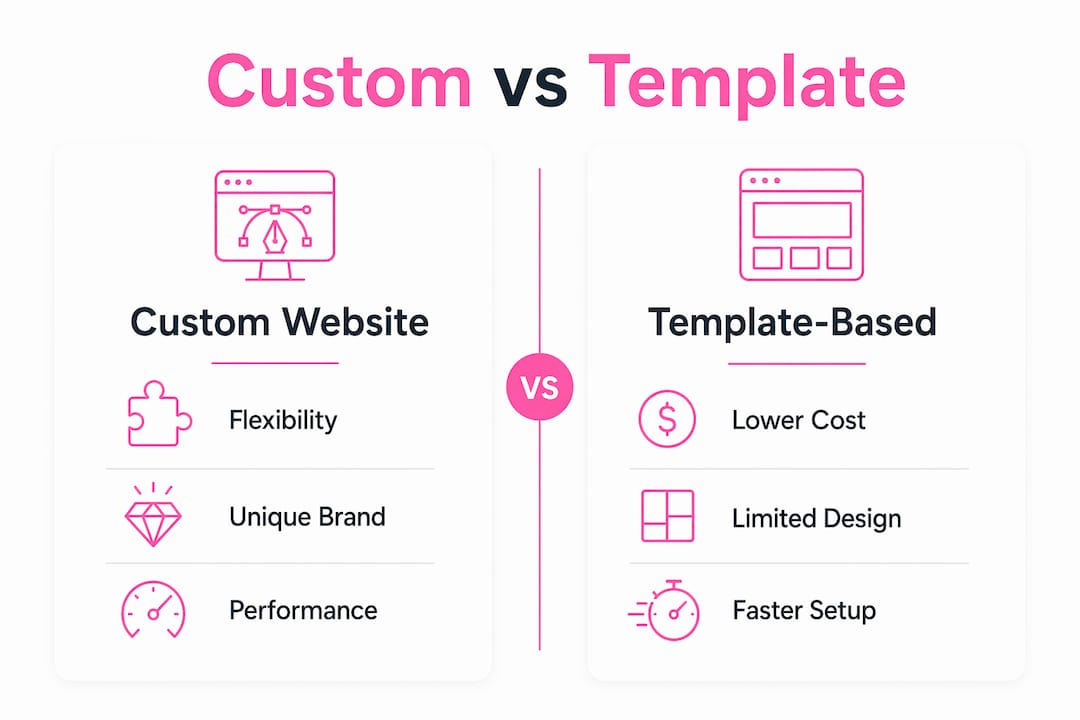
Custom website design, or bespoke web design, starts from a blank codebase. Every layout, color choice, navigation structure, and interaction is built to serve your specific business. Template-based design, by contrast, starts from a pre-built framework sold to thousands of businesses simultaneously. Platforms like Squarespace, Wix, and Shopify's free themes are the most common examples.
The distinction matters more than most business owners realize. True bespoke websites start from a blank codebase rather than heavily modified templates, which limits flexibility. Many agencies claim to offer custom design but deliver a renamed theme with a logo swap. That is not custom development. That is template customization, and it carries all the same constraints.

Here is a direct comparison of the two approaches:
| Feature | Custom Website | Template-Based Website |
|---|---|---|
| Design flexibility | Unlimited | Restricted to theme options |
| Brand uniqueness | Fully unique | Shared with thousands of sites |
| SEO optimization | Code built for performance | Bloated code, slower load times |
| Scalability | Built to grow with you | Limited by platform constraints |
| Upfront cost | Higher ($3,000–$30,000+) | Lower ($0–$500) |
| Long-term value | High for revenue-focused sites | Moderate for simple brochure sites |
Hybrid approaches using customized templates on platforms like WordPress or Shopify can offer some design differentiation but still come with limitations. They may reduce upfront costs but do not provide the full flexibility of a custom tech stack. For a business where the website is a primary revenue channel, that limitation has a real dollar cost.
The long-term business impact of choosing custom design is significant. A template locks you into someone else's architecture. A custom site is built around your sales funnel, your content structure, and your customer journey.
What are the benefits of custom web design for small businesses?
The advantages of custom websites go well beyond aesthetics. Here are the core benefits that directly affect your bottom line:
- Brand differentiation. Custom design weaves brand DNA into every element using unique typography, animation, and layouts tailored to specific audiences. That level of personalization creates strong brand credibility that a shared template cannot replicate.
- Conversion optimization. Every call-to-action, form placement, and page flow is designed around how your specific customers behave. Template sites force you to adapt your business to their structure. Custom sites adapt to yours.
- Technical SEO performance. Custom websites focus on optimized code and load only necessary assets, resulting in better Core Web Vitals and higher Google rankings. Template platforms often ship with bloated JavaScript and unused CSS that drag down your scores. Understanding why load speed matters for SEO makes this benefit concrete.
- Scalability. A custom site is built with your growth in mind. You can add features, integrations, or entirely new sections without fighting the platform's limitations.
- Security control. Custom builds allow you to implement SSL, DDoS protection, and automated testing from day one, rather than relying on a platform's one-size-fits-all security layer.
Pro Tip: Before signing with any agency, ask to see the actual codebase of a previous project. If they cannot show you a blank-slate build, you are likely getting a modified theme, not a truly custom site.
The combined effect of these benefits is a website that performs better in search, converts more visitors into customers, and represents your brand with precision.
How much does custom website design cost and what is the ROI?
Budget is where most small business owners hesitate. The numbers are real: custom-built websites cost 5–10 times more than DIY or template options. That cost differential is significant, but the cost-benefit analysis favors custom sites for lead-generation or sales-critical businesses.
Here is a practical breakdown of what to expect:
| Project Type | Typical Cost Range | Timeline | ROI Scenario |
|---|---|---|---|
| Small business brochure site | $3,000–$8,000 | 2–4 weeks | Strong if site drives local leads |
| E-commerce custom build | $10,000–$30,000 | 4–8 weeks | High when conversion rate improves |
| App-integrated or complex site | $30,000+ | 8–16 weeks | Justified for SaaS or high-volume retail |
Standard small business websites typically complete within one month. Large-scale or app-heavy sites take longer. For most entrepreneurs, the 2–4 week window is realistic if you come prepared with clear goals and brand assets.
The ROI calculation is straightforward. If your website generates leads worth $5,000 per month and a custom redesign improves your conversion rate by 20%, that is $1,000 in additional monthly revenue. A $6,000 custom site pays for itself in six months. A template site that converts at half the rate never closes that gap.
Pro Tip: Ask any agency you vet whether they build from a blank codebase or start from a starter theme. Some agencies use starter frameworks and claim bespoke status. The answer tells you immediately whether you are getting true custom website design services or a premium-priced template job.
For a deeper look at making smart website investment decisions, the ROI framework applies directly to custom development decisions.
How do you design a custom website step by step?
The process of custom website development follows a clear sequence. Skipping steps is where projects go over budget and over deadline.
- Discovery and strategy. Define your business goals, target customers, and key user actions. What do you want visitors to do? Buy, call, book, or subscribe? Every design decision flows from this answer.
- Wireframing and prototyping. Before a single line of code is written, tools like Figma enable testing of user flows and visual layouts. This phase catches structural problems early, when changes cost time rather than money.
- Design and client review. The visual design is built on top of approved wireframes. Colors, typography, imagery, and micro-interactions are finalized here. Client feedback at this stage is structured and efficient.
- Development. The approved design is coded. Tech stack choices matter here. Next.js delivers fast, server-rendered pages. A headless CMS like Contentful or Sanity gives you content control without touching code. These choices affect both performance and your ability to update the site yourself.
- Testing and quality assurance. Responsive behavior across devices, load speed, form functionality, and browser compatibility are all verified. Security-first solutions include SSL, DDoS protection, and automated testing at this stage.
- Launch and handoff. The site goes live. A good agency provides documentation and training so you can manage content independently.
Pro Tip: Use the website readiness checklist before your first agency meeting. Arriving with clear answers to brand, audience, and goal questions cuts weeks off the discovery phase.
Wireframing and prototyping prior to coding is critical to align user journeys and avoid expensive fixes during development. Agencies that skip this step are cutting corners that you will pay for later.
Key takeaways
Custom website design delivers measurable business advantages over templates when your website is a primary driver of leads or revenue.
| Point | Details |
|---|---|
| Custom vs. template | Custom sites start from a blank codebase; templates limit flexibility and brand uniqueness. |
| Core SEO advantage | Optimized code and lean asset loading improve Core Web Vitals and Google rankings directly. |
| Cost and timeline | Expect $3,000–$30,000 and a 2–4 week timeline for most small business custom projects. |
| ROI is measurable | A conversion rate improvement of 20% on a lead-generating site can recover costs within months. |
| Process discipline | Wireframing in Figma before development prevents costly structural changes during the build. |
Why i think most small businesses underestimate custom design
After working with hundreds of businesses on their digital presence, the pattern I see most often is this: a business owner spends $500 on a template site, watches it underperform for two years, then spends $12,000 on a custom rebuild. The total cost ends up higher than if they had started with custom development. The template felt like the safe choice. It was not.
The misconception I hear constantly is that custom design is only for large companies. That is wrong. A local law firm, a specialty retailer, or a B2B service provider all have specific customer journeys that a generic template cannot serve well. The brand credibility gap between a custom site and a template site is visible to your customers, even if they cannot articulate why one feels more trustworthy than the other.
What I find most underappreciated is the SEO compounding effect. A custom site built with clean code and fast load times does not just rank better at launch. It accumulates ranking advantages over time because Google's Core Web Vitals scoring rewards consistent performance. A template site loaded with plugin bloat starts behind and falls further back every month.
My honest recommendation: if your website is responsible for generating even 20% of your revenue or leads, the custom route is not a luxury. It is the more financially rational decision. Start with a clear brief, vet your agency on their codebase practices, and treat the discovery phase as seriously as the design phase.
— Ville
How Verkkosivu builds custom websites that actually perform
Verkkosivu specializes in fully custom website design built without templates, delivered with load times under one second and SEO optimization built into every layer of the code. With more than 100 successful projects and a perfect 5-star rating on Google, Verkkosivu works with small and medium-sized businesses that need a professional digital presence fast, often within 48 hours of project kickoff.
Every project includes an initial consultation, A/B testing capability, and ongoing maintenance support with no hidden costs. If you are a small business owner who needs a site that wins customers rather than just existing online, Verkkosivu delivers that with a hands-on, client-first process from first call to final launch.
FAQ
What is the difference between custom and bespoke web design?
Custom website design and bespoke web design refer to the same practice: building a website from a blank codebase tailored to a specific business. Both terms are used interchangeably in the industry.
How long does a custom website take to build?
Most small business custom websites complete within 2–4 weeks. Complex builds with app integrations or large e-commerce catalogs can take 8–16 weeks depending on scope.
Is custom web design worth it for a small business?
Custom design is worth the investment when your website directly generates leads or revenue. A 20% improvement in conversion rate on a lead-generating site typically recovers the cost within six months.
What tools do developers use for custom website design?
Common tools include Figma for wireframing and prototyping, Next.js for fast server-rendered pages, and headless CMS platforms like Contentful or Sanity for flexible content management.
How do i know if an agency is truly building a custom site?
Ask to see the codebase of a previous project and confirm they build from a blank slate rather than a starter theme. True bespoke development never starts from a pre-built framework, and any agency doing genuine custom work will confirm this without hesitation.