
Website return on investment (ROI) is defined as the measurable revenue your business generates relative to the total cost of building, running, and maintaining your website. The role of website ROI explained simply: it tells you whether your website is earning its keep or draining your budget. 67% of businesses see measurable revenue growth by improving website performance. That number confirms your site is not a brochure. It is a revenue asset. Yet 40% of marketers still struggle to prove website ROI, which means most small business owners are flying blind on one of their biggest investments.
How to measure website ROI effectively
Website ROI uses a straightforward formula: subtract your total website investment from the revenue it generates, divide by the investment, and multiply by 100. The result is a percentage that tells you how efficiently your site converts spending into income.
The tricky part is defining "total investment" correctly. Most small business owners count only the initial design or build cost. True ROI calculation requires total cost of ownership, which includes hosting fees, security certificates, content updates, maintenance, and ongoing optimization. Skipping these costs inflates your ROI number and leads to bad decisions.

On the revenue side, you need to track more than purchases. Conversion actions like form submissions, booked calls, and direct purchases all quantify what your website produces. Beyond those, customer lifetime value (CLV) and pipeline contribution matter. A visitor who fills out a contact form and becomes a $10,000 annual client represents far more value than a single transaction.
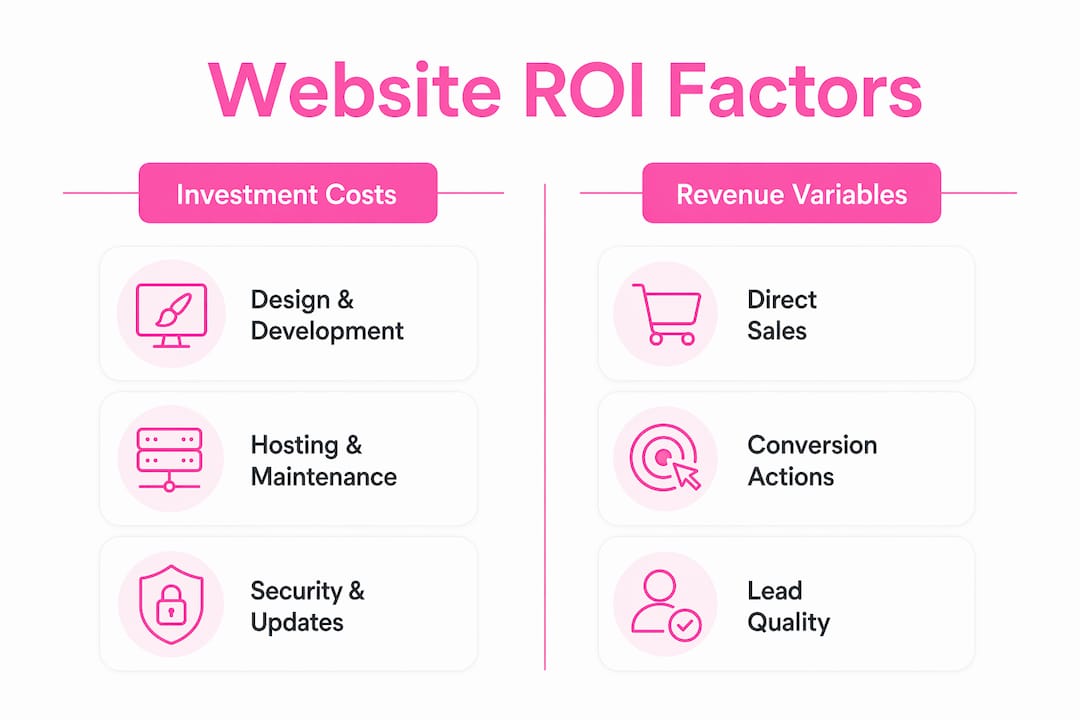
The table below maps the two sides of the ROI equation.
| Investment costs | Revenue variables |
|---|---|
| Initial design and development | Direct online purchases |
| Hosting and domain fees | Form submissions and booked calls |
| Security and SSL certificates | Lead quality and close rate |
| Content creation and updates | Customer lifetime value (CLV) |
| Maintenance and bug fixes | Pipeline contribution across channels |
| SEO and performance optimization | Repeat purchase and retention revenue |
Pro Tip: Track your website health metrics monthly. Gaps in data collection are the most common reason ROI calculations come out wrong.
Why website ROI matters for business growth
Website ROI is the clearest signal you have for where to spend your next marketing dollar. Without it, you are guessing whether to invest in SEO, paid ads, or a site redesign. With it, you make decisions based on what actually produces revenue.
A well-built site that addresses visitor needs leads to shorter sales cycles and higher customer conversions. That is not a minor efficiency gain. A shorter sales cycle means your team closes deals faster, which frees capacity to pursue more leads without adding headcount.
Understanding your website return on investment also changes how you think about the site itself. Most small business owners treat a website as a one-time project. The ones who grow the fastest treat it as a core business asset, similar to a sales rep who needs coaching, tools, and performance reviews.
Key benefits of tracking and improving website ROI for small businesses:
- Smarter budget allocation. You know which pages and campaigns generate revenue, so you stop funding what does not work.
- Higher lead quality. Optimizing for conversion rate and lead quality filters out poor-fit prospects before they reach your sales team.
- Faster decision cycles. Data replaces gut feeling when you evaluate redesigns, content investments, or new features.
- Compounding returns. Ongoing optimization builds on each previous improvement, so ROI grows over time rather than plateauing.
- Stronger competitive position. A site that consistently converts outperforms competitors who treat their web presence as static.
Pro Tip: Avoid vanity metrics like total page views or social shares. Focus on Conversion Rate, Average Order Value (AOV), and Lead Quality. These three KPIs connect directly to revenue.
What nuances affect website ROI calculations?
The most common mistake in calculating website return on investment is treating all leads as equal. Lead quality and close rate impact ROI more than raw lead volume. Ten highly qualified leads who convert at 50% outperform 100 low-quality leads who convert at 2%. Your website's job is to attract the right visitors, not just more visitors.
A second complexity is attribution. Your website influences revenue across channels, not only through direct transactions. A prospect might discover you through Google, read your blog, then call your sales line. The website drove that sale, but a narrow attribution model would miss it entirely. Pipeline contribution, the share of closed deals where the website played a role, captures this indirect impact.
The table below contrasts surface-level KPIs with the deeper revenue metrics that produce accurate ROI assessments.
| Surface-level KPIs | Deep revenue metrics |
|---|---|
| Total page views | Conversion rate by traffic source |
| Bounce rate | Lead quality score and close rate |
| Social media followers | Customer lifetime value (CLV) |
| Time on page | Pipeline contribution |
| Number of leads | Average Order Value (AOV) |
| Email open rate | Revenue per visitor |
Multi-year perspective also changes the picture. A site that costs $8,000 to build and generates $3,000 in year one looks like a poor investment. The same site generating $15,000 in year three, after iterative improvements, tells a very different story. ROI is not a snapshot. It is a trend.
How can small businesses improve their website ROI?
Improving your website's return on investment follows a clear sequence. Skipping steps wastes money. Following them compounds gains.
- Audit your current performance. Pull data on conversion rate, bounce rate by page, and lead source. Identify the three pages that generate the most revenue and the three that generate the least.
- Fix site speed first. Website speed directly affects revenue. Slow pages lose visitors before they convert. Aim for load times under two seconds on mobile.
- Clarify your calls to action. Every page needs one clear next step. Visitors should never have to guess what to do. Vague CTAs kill conversion rates.
- Invest in conversion rate optimization. Use A/B testing to compare headlines, form lengths, and page layouts. Small changes in conversion rate produce large changes in revenue over time. A conversion rate optimization approach turns existing traffic into more revenue without increasing ad spend.
- Build SEO into the site structure. Organic search traffic compounds over time. Pages that rank well generate leads for months or years without additional spend. SEO and content marketing are among the highest-ROI channels for small businesses.
- Track meaningful KPIs weekly. Set up goal tracking in Google Analytics 4 for form submissions, purchases, and phone call clicks. Review the data weekly and act on what you find.
- Partner with a specialist when needed. Website investment best practices for small businesses consistently show that professional development and ongoing support accelerate ROI compared to DIY approaches.
Pro Tip: Balance short-term wins with long-term gains. A faster checkout page might lift revenue this month. A content strategy built around your best keywords will lift revenue for the next three years. You need both.
Key Takeaways
Website ROI is the single most reliable measure of whether your website is a business asset or a business cost, and improving it requires tracking total investment, meaningful revenue metrics, and lead quality together.
| Point | Details |
|---|---|
| Define total investment accurately | Include hosting, maintenance, security, and updates, not just the initial build cost. |
| Track revenue beyond purchases | Measure form submissions, booked calls, CLV, and pipeline contribution for a complete picture. |
| Prioritize lead quality over volume | Fewer high-quality leads consistently produce better ROI than large volumes of poor-fit prospects. |
| Treat your site as an ongoing asset | Ongoing optimization compounds returns over time, with each improvement building on the last. |
| Use deep metrics, not vanity KPIs | Focus on Conversion Rate, AOV, and Lead Quality to connect website activity to real revenue. |
The uncomfortable truth about website ROI most owners miss
I have worked with dozens of small business owners who were convinced their website was underperforming. When we dug into the data, the real problem was almost never the design. It was the measurement. They were tracking page views and bounce rates while ignoring conversion rate, lead quality, and pipeline contribution. They were optimizing for the wrong signals.
The shift that changes everything is treating your website the way you treat a sales rep. You would not keep a sales rep on the payroll without tracking their close rate, deal size, and pipeline contribution. Your website deserves the same rigor. When you start measuring it that way, the investment decisions become obvious. You stop debating whether to spend $500 on a new banner image and start asking whether a faster checkout page would recover $5,000 in abandoned carts.
The other mistake I see constantly is the "launch and leave" approach. A website is not a brochure you print once. Every month you do not optimize it, you are leaving compounding gains on the table. The businesses I have seen grow fastest are the ones that treat their website as a living system, reviewing performance data, running tests, and making incremental improvements every quarter.
My honest advice: start with the three metrics that matter most. Conversion Rate, Average Order Value, and Lead Quality. Get those right before you touch anything else. Once you have a baseline, every subsequent decision becomes data-driven rather than a guess.
— Ville
Verkkosivu builds websites that earn their investment back
Small business owners who want a website that generates measurable returns need more than good design. They need speed, structure, and ongoing support built in from day one.

Verkkosivu specializes in custom websites that win customers for small and medium-sized businesses. Every site loads in under one second, is built without templates, and is tailored to your brand and conversion goals. With more than 100 completed projects and a perfect 5-star rating on Google, Verkkosivu delivers results fast, often within 48 hours, with no hidden costs. From SEO and A/B testing to ongoing maintenance, the full service is designed to grow your website ROI from launch day forward.
FAQ
What is website ROI?
Website ROI is the revenue your business generates from its website relative to the total cost of building and maintaining it. It measures whether your website investment produces a financial return.
How do I calculate website return on investment?
Subtract your total website costs from the revenue the site generates, divide by the total costs, and multiply by 100. Total costs must include hosting, maintenance, and updates, not just the initial build.
Why do so many businesses struggle to prove website ROI?
40% of marketers cite proving ROI as a primary challenge because they track incomplete metrics and exclude ongoing costs from their calculations. Accurate ROI requires both full cost accounting and revenue attribution across all channels.
Does lead quality affect website ROI more than lead volume?
Lead quality has a greater impact on ROI than raw lead count. A smaller number of high-quality leads with a high close rate consistently produces better financial returns than a large volume of poor-fit prospects.
How long does it take to see improved website ROI?
Some improvements, like faster load times and clearer calls to action, produce results within weeks. SEO and content investments typically compound over six to eighteen months, with ROI growing as the site builds authority and organic traffic.